Weekly lawn care in DFW runs roughly $215 to $370 per month during the mowing season for a standard residential lot, based on a per-visit rate of $50 to $85 for mowing, edging, line-trimming, and blow-off. Larger lots and every-other-week schedules run $75 to $140 per visit. A full annual program that bundles weekly mowing with fertilization, pre-emergent, aeration, and seasonal cleanups runs $2,400 to $5,800 per year for a standard lot.
The monthly number trips people up because lawn care is almost never billed monthly. It is billed per visit, and a month holds about 4.3 of them. So the honest way to read any monthly figure is to work backward to the per-visit rate and the scope behind it. Here is what those numbers actually cover in North Texas, and where the real variation comes from.
What Lawn Care Actually Costs per Month in DFW
Start with the per-visit rate, because that is the number a landscaper is actually quoting.
| Lot | Per visit | Roughly per month, weekly |
|---|---|---|
| Standard residential, under 8,000 sq ft mowable | $50 to $65 for the standard routine, up to $85 on the larger end | $215 to $370 |
| Larger residential, 8,000 to 15,000 sq ft | $65 to $95 | $280 to $410 |
| Estate, half-acre and up | $95 to $175 | $410 to $750 |
| Larger lots on an every-other-week schedule | $75 to $140 | Two visits, so $150 to $280 |
The standard routine at every one of those rates means the same four things: mow, edge every bed and walk, line-trim the fence lines and tree rings, and blow every hard surface clean. If a quote is meaningfully below that range, something in that list is missing, or the prep and cleanup are not happening.
A typical quarter-acre in Carrollton or Coppell, with a house and driveway taking up part of the lot, usually leaves 6,000 to 9,000 square feet of actual mowable turf. That lands most of these yards right at the top of the standard tier or the bottom of the larger tier, which in practice means about $60 to $75 a visit and roughly $260 to $320 a month while the grass is growing. Those are the same route rates in both cities. Coppell does not get charged more for being Coppell, and neither does anywhere else on the route.
One thing worth saying plainly: you are not paying that every month of the year. Warm-season grass in North Texas grows hard from roughly April into October and goes dormant after the first real cold snap. A sensible schedule drops cadence in the dormant months, so the annual total is well below twelve times the peak-season monthly number. Any full-year contract that bills the same weekly rate through January is charging you to mow grass that is not growing.
For project services such as sod and hardscaping, see our DFW landscaping cost guide. The lawn-care figures here are general budgeting guidance for comparing providers.
What Changes the Number: Lot Size, Grass, and Access
Square footage is the biggest driver, but it is not the only one, and the others are the reason two houses on the same street can get different quotes.
Mowable square footage, not lot size. A quarter-acre lot with a big house, a wide driveway, and deep beds might only have 5,000 square feet of grass. A quarter-acre with a small ranch house and open turf might have 9,000. The second one costs more to service even though the deed says they are the same.
Grass type, because growth rate is labor. Bermuda in June grows fast enough to need weekly cutting and will look ragged if it slips to ten days. St. Augustine grows fast too and its thick runners are slower to trim cleanly. Zoysia grows more slowly, which is genuinely less mowing over a season. Grass choice is mostly about your sun, and we covered that side of it in the complete guide to lawn care in North Texas, but it does show up in the labor.
Edging length. Two yards with identical turf can differ by twenty minutes if one has a curved bed system, a long sidewalk, a tree ring for every tree, and a pool deck. Edging and trimming is most of the finish work.
Access. A gated backyard the crew has to carry equipment through, a steep slope that will not take a riding mower, or a yard the truck cannot park near all add time. Slopes in particular push the work to push mowers and string trimmers.
Bagging versus mulching. Mulching clippings back into the lawn is the default and it is better for the turf, since the clippings return nitrogen and moisture. Bagging means hauling the clippings off, which is real labor and real disposal, so it usually carries an upcharge. It is worth paying for in specific cases, like when the lawn has an active fungus you do not want to spread, and not worth paying for every week as a habit.
Weekly vs. Every-Other-Week, and Why Biweekly Costs More per Visit
This surprises people every time: going to every other week does not cut your bill in half, because the per-visit rate goes up.
The reason is simple. In peak season the crew arriving on day fourteen is cutting roughly twice the growth of the crew arriving on day seven. That is a slower pass, more strain on the equipment, more clippings, and much more likely to require bagging because the clipping volume is too heavy to mulch back in without smothering the lawn. Larger lots and every-other-week schedules land in the $75 to $140 per visit range for exactly that reason.
There is an agronomic cost too. The rule of thumb is never remove more than a third of the blade in one cut. On Bermuda in June, fourteen days of growth means the crew either scalps the lawn to get it back to height, which stresses it right when the heat is worst, or leaves it too tall and it looks unfinished. We went through the timing in detail in how often you should mow a DFW lawn.
Where every-other-week genuinely makes sense: the shoulder seasons, dormant winter months, Zoysia lawns that grow slowly by nature, and shaded yards that are not putting on much growth. Where it does not: any full-sun Bermuda lawn between May and September. Two visits a month at $75 to $140 runs $150 to $280, so the savings are real, just smaller than people expect, and in peak season you pay for them in how the lawn looks.
What "Full Service" Usually Includes, and What It Does Not
The single biggest source of quote confusion is that "lawn care" means mowing to one company and a whole program to another. The per-visit rate above buys the mow, edge, trim, and blow. It does not buy the things that actually determine whether your lawn is thick and green.
Those live separately, and here is roughly what they run:
- Fertilization program, 5 to 6 applications across the year: $400 to $900 per year depending on lot size.
- Pre-emergent, twice a year in February and September: $150 to $300 per year. This is the one that stops crabgrass before it sprouts, and it only works if it goes down before the weeds do.
- Core aeration, timed for active growth and recovery rather than a fixed October date: $150 to $400 as a one-time service. On Blackland clay this matters more than it does most places, because compacted Houston Black clay chokes root systems.
- Spring cleanup, March: $300 to $1,500 depending on scope.
- Fall cleanup, November: $250 to $1,200.
Bundled together with weekly mowing, an annual program runs $2,400 to $5,800 per year for a standard residential lot. Averaged across all twelve months that is roughly $200 to $483 a month, and it is generally cheaper per service than buying each piece separately, because the crew is already on the property.
Our seasonal fertilization guide explains the feeding side of lawn care. If you are weighing professional help versus doing it yourself, see is professional lawn care worth it in DFW.
What DFW Homeowners Overpay For
These are useful ways to compare the options.
Weekly mowing through dormancy. From roughly December through February, warm-season grass in North Texas is not growing. Paying a full weekly rate through that stretch is paying for visits the lawn does not need. Cadence should drop.
Bagging every single visit. Unless there is a reason, mulching is better for the lawn and cheaper for you. Paying a weekly bagging upcharge out of habit is money for nothing, and it removes nitrogen the turf would otherwise get back for free.
More fertilizer applications than the lawn needs. A program with 5 or 6 well-timed applications does the job. Programs selling 8 or 10 are selling visits, not results, and over-feeding actually raises disease pressure.
Paying a premium for the address. Route rates should be driven by lot size and drive time, not by the median home price of the zip code. If a company quotes a Park Cities or Coppell yard well above an identical yard one city over, ask why.
Chasing the lowest bid. The flip side. A quote well under the ranges here is usually missing the edging and cleanup, is uninsured, or is a subcontractor who will not be back next season. That is not a saving, it is a deferral.
How to Compare Two Quotes
The trick is that quotes are rarely comparable as written, so normalize them before you decide.
- Convert everything to per visit. One company quotes monthly, another per visit, another annually. Divide it all down to the same unit before you compare, and use 4.3 visits per month rather than 4.
- Match the scope line by line. Does each quote include edging, line-trimming, and blow-off, or just the mow? Is bagging included or an upcharge? Are cleanups in or out?
- Ask what happens in the dormant months. A twelve-month flat rate can be a good deal or a bad one depending entirely on whether the cadence drops.
- Insist the quote comes after someone sees the property. A price given over the phone, before anyone has measured the mowable area or seen the gate and the slope, is a guess. That is the same standard we lay out in how to choose the right landscaper, along with the insurance and in-house-crew questions worth asking.
- Find out who actually shows up. Companies that sell the job and subcontract the work are why the third-month experience often stops matching the first.
Getting a Real Number for Your Yard
Ranges are useful for sanity-checking a quote. They are not a substitute for someone measuring your actual mowable square footage, which is the number the price is really built on.
If the lawn is far enough gone that maintenance will not bring it back, replacement may be worth considering. Our Carrollton front yard sod install shows what that can involve. We offer sod installation estimates across our service area.
Free on-site estimate, and you get a written fixed price rather than a phone guess.
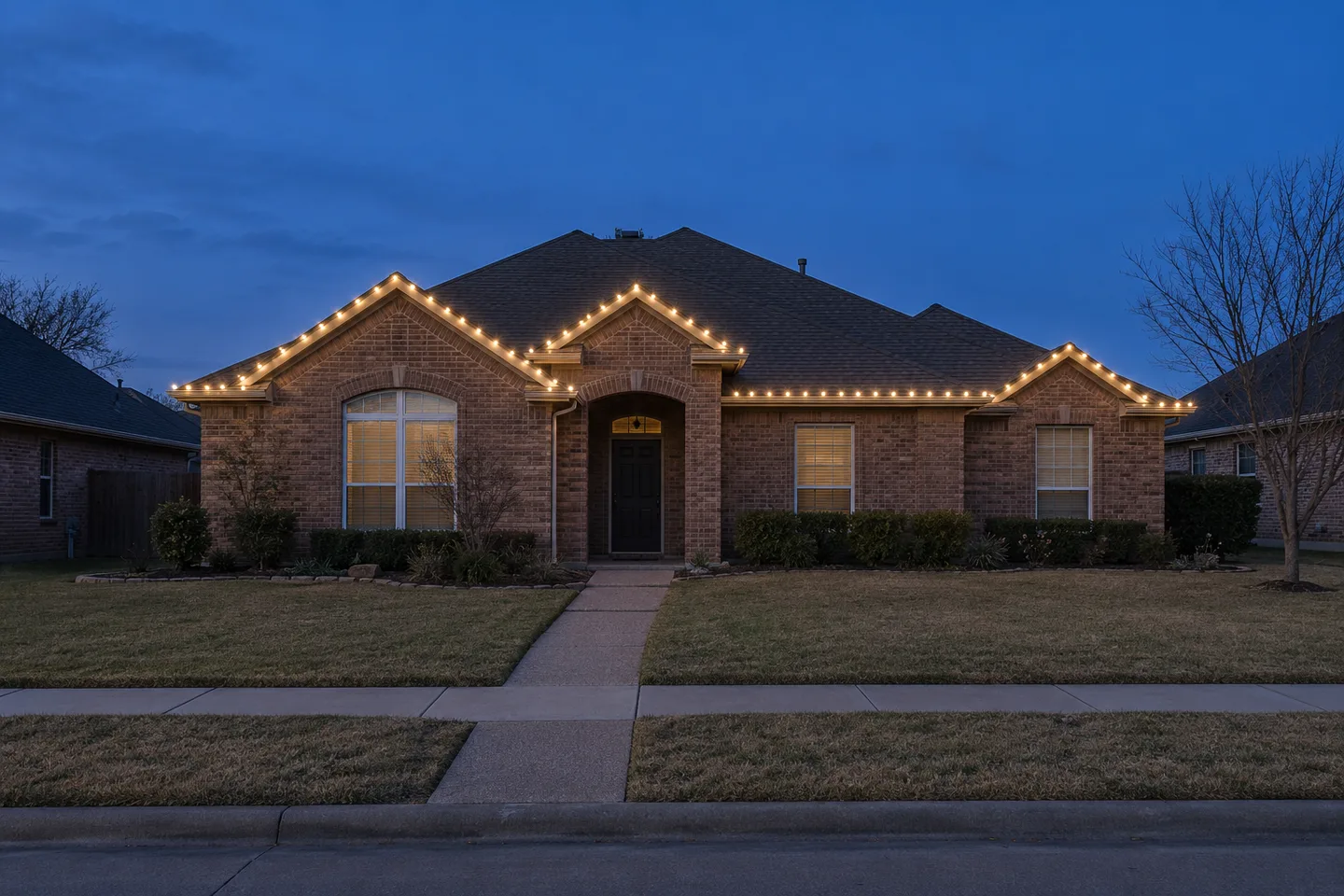
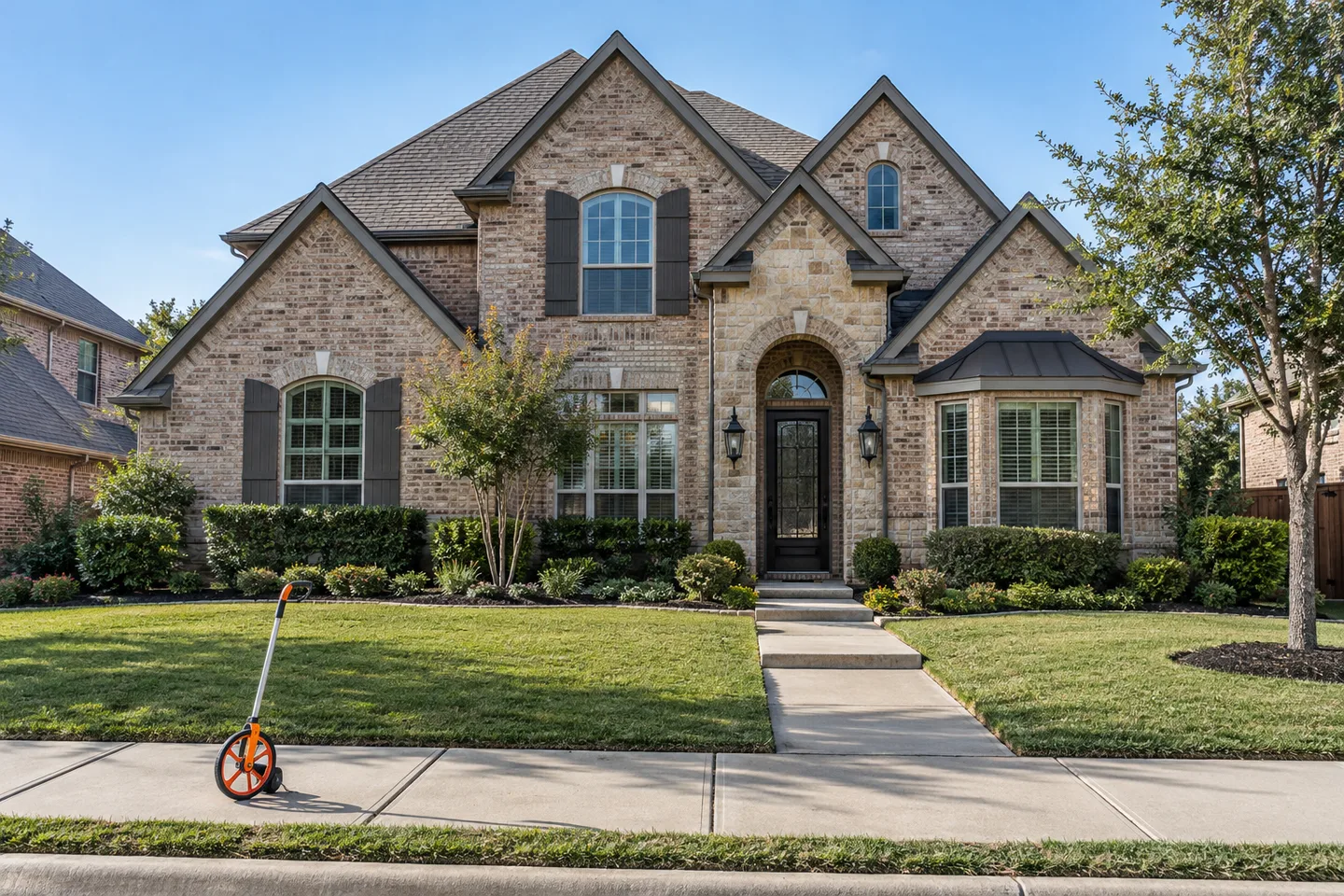
We also offer Christmas light installation across that service area. It is priced per linear foot of measured roofline, with the timer, a mid-season service visit, and January takedown in the number.
For the timing behind that recommendation, Texas A&M recommends core aeration while Bermuda is actively growing. Grass type, soil moisture, and recovery conditions matter more than a date on the calendar.
For a smaller lot, compare quotes by the actual mowable area and the work included on each visit.