Pick a landscaper who is insured (general liability plus workers' comp), has at least three verifiable references in your zip code from the last 12 months, gives you a written fixed-price quote after walking your property in person, and runs their own crews instead of handing the job to a subcontractor. That is the four-part filter. Anything that fails one of those four is the wrong call, no matter how cheap the bid looks.
This guide walks through each one, plus the warning signs that come up at every step of the DFW hiring process. We have been working across Carrollton, Plano, Frisco, Dallas, and the rest of the metroplex for over 15 years. The bad-hire stories we have heard from new customers all share the same root cause: they skipped one of those four checks.
Key Takeaways
- The four non-negotiables: real insurance, real local references, a fixed-price written quote that follows an on-site visit, and crews the company actually employs.
- A price quoted over the phone without anyone seeing your yard is a guess. On clay soil, the prep is the part that moves the number most, and nobody can see prep from a phone call.
- North Texas clay soil makes prep work the single biggest cost driver. Cheap quotes almost always skip prep.
- Most DFW HOAs (Castle Hills, Stonebriar, Vaquero) require written approval before sod or hardscape. A good landscaper handles that paperwork for you.
- Spring (March to May) and fall (September to November) are the booked-out seasons. If you want a quality crew, reserve 2 to 4 weeks ahead.
- See our full DFW landscaping pricing ranges for what real work actually costs.
1. Insurance Is the First Filter
Ask for two certificates before any work starts: general liability and workers' compensation. Texas does not legally require contractors to carry workers' comp, which is exactly why a lot of low-bid operators skip it. If a crew member gets hurt on your property and the landscaper does not carry workers' comp, your homeowner's policy is the next stop.
A real landscaper will email you a Certificate of Insurance (COI) from their broker without hesitation. They will name your property as an additional insured if you ask. They will tell you the broker's name and phone number so you can verify the policy is active. If the answer is "we'll get you that next week" or "we have it but it is at the office," walk away.
One follow-up question that separates the serious from the rest: does that policy cover the people who will actually be in my yard? If the work gets subcontracted, the sub's insurance is what matters, and a certificate from the company that sold you the job does not cover them. More on that in filter four.
2. Verify the References, and Ask to See Comparable Local Work
Anyone can hand you a list of names. The list is only useful if you actually call. Ask for:
- At least three references from completed jobs in the last 12 months.
- At least one in your zip code or an adjacent one. A landscaper who works Lakewood mature pecans is solving a different problem than a Frisco new-build crew. Local-to-you matters.
- Permission to drive by the work. A great landscaper will say yes immediately and even tell you what to look for.
When you call the reference, ask three things: was the work done on time, did the final price match the quote, and would they hire the same company again. The third question gets the most honest answer because it is forward-looking.
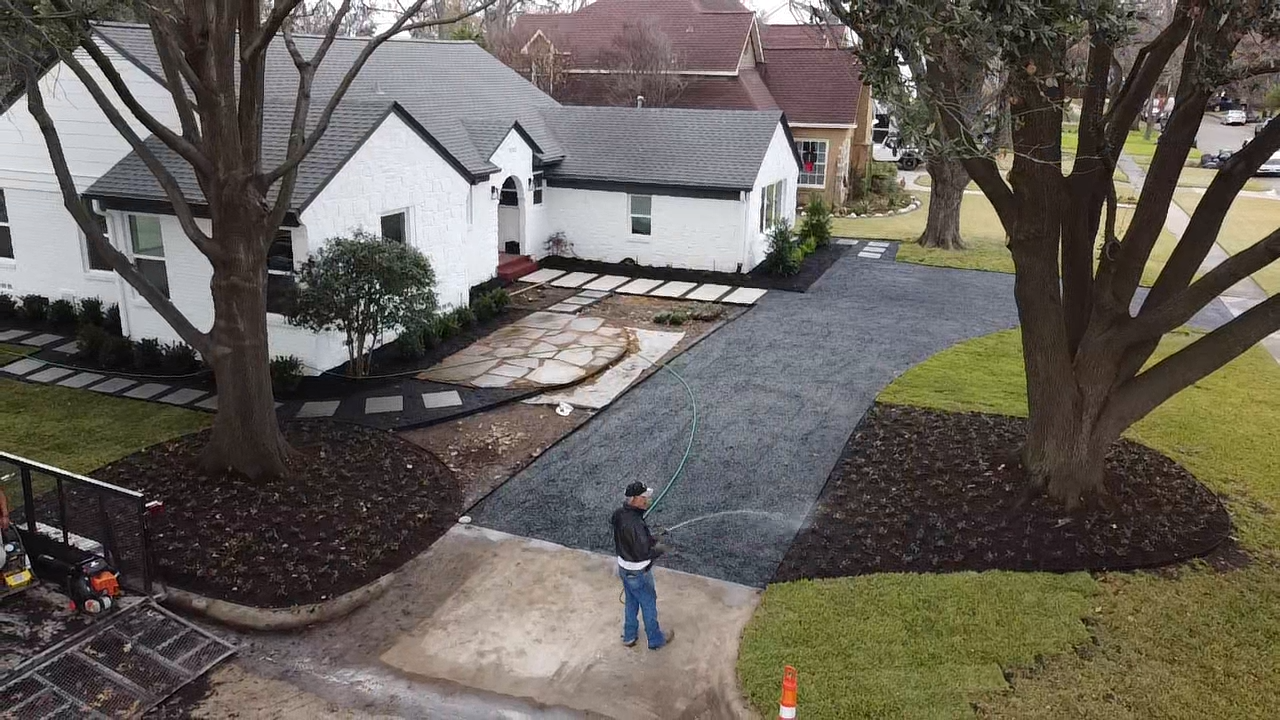
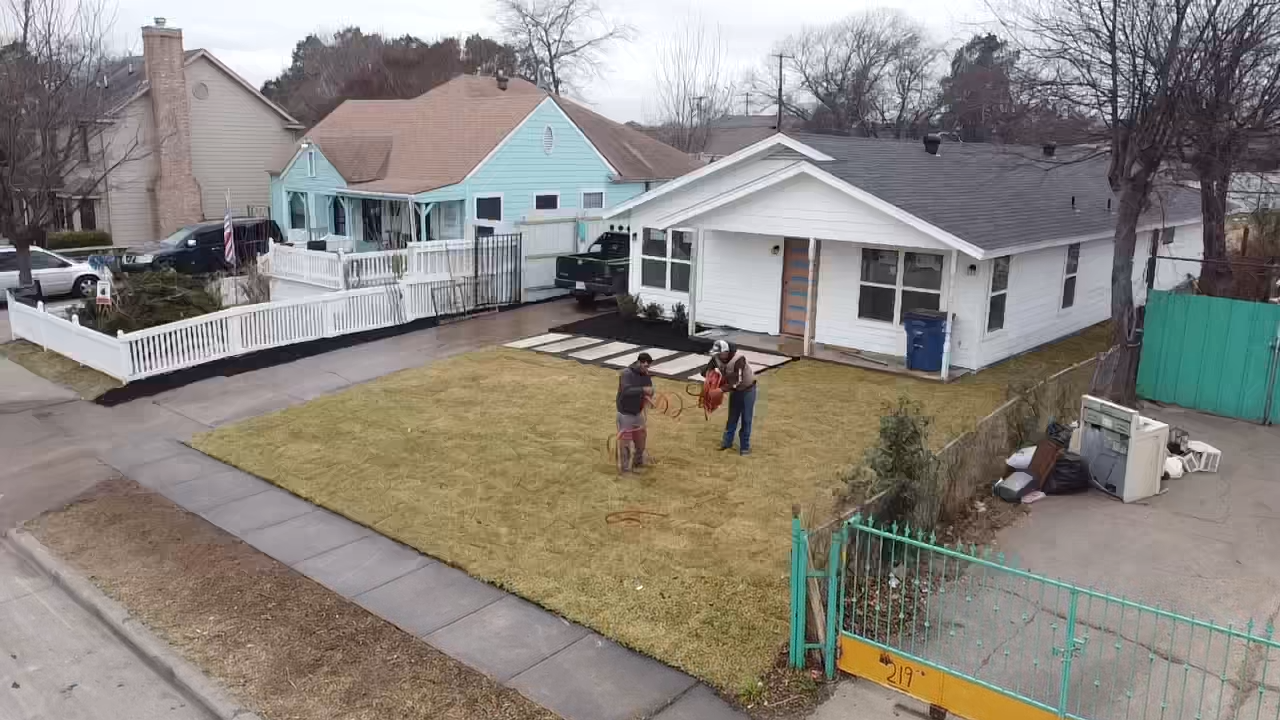
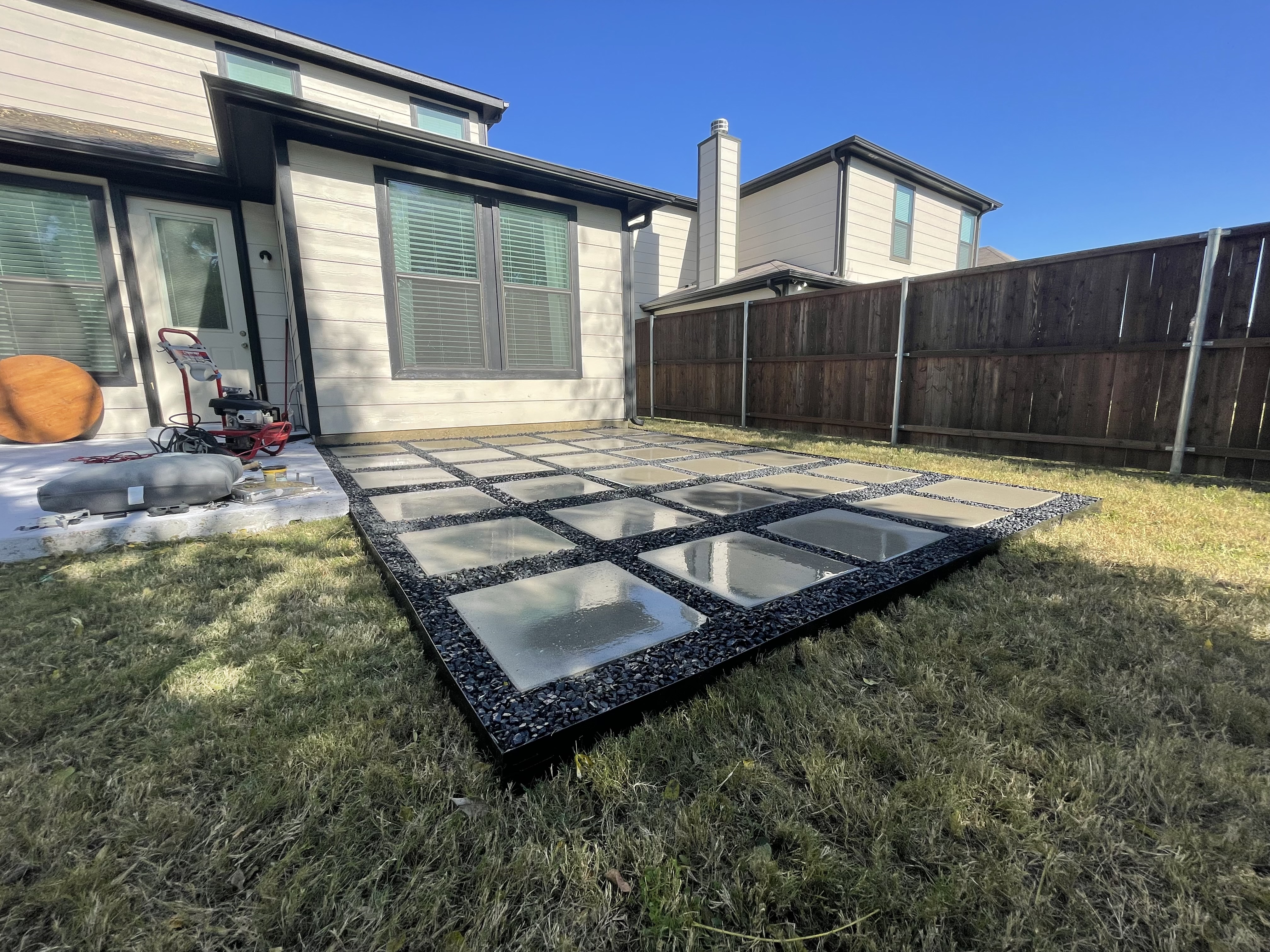
Then ask for photos of jobs like yours, nearby. Not a stock gallery, and not the one showpiece project from four years ago: a half-dead Bermuda lawn in a neighborhood near you, before and during and after. A company that works your area every week can produce those in about a minute, because they are on somebody's phone from last month. A company that cannot is either new to your area or showing you somebody else's portfolio. Ours are in our recent transformations gallery if you want to see what that should look like.
3. Get a Written, Fixed-Price Quote, and Only After Someone Walks the Property
Verbal pricing is the single biggest source of post-job arguments in this industry. A real landscaper writes the scope, the materials, the timeline, and the price on paper (or in an email PDF) and signs it. The quote should also list what is excluded so you know exactly where the scope ends.
Just as important is when the number shows up. A price quoted over the phone, before anyone has stood in your yard, is a guess dressed up as a quote. It is also the number most likely to change once the crew arrives and discovers the grade runs the wrong way, or the old turf is thicker than expected, or the clay under the builder sod was never broken up. On a North Texas lot the prep is the biggest single cost driver, and prep is exactly the part nobody can assess over the phone.
So the sequence matters: someone comes out, walks the property, measures, asks how you use the yard, and then sends a fixed price in writing. If a company is willing to name a firm price sight unseen, either they are padding it heavily to cover what they cannot see, or you are getting a low number now and a change order later.
The "day rate" model is a red flag for residential work for the same reason. It transfers all the risk to you: if the crew is slow, if they hit a problem, if they have to come back tomorrow, the meter keeps running. A fixed-price quote means the crew has skin in the game to finish properly.
For larger projects (sod over $3,000, hardscape, full landscape design), the quote should also include a payment schedule (typically deposit on signing, balance on completion) and a written warranty clause covering what happens if something fails.
4. Find Out Who Is Actually Doing the Work
This is the filter most homeowners never think to apply, and it explains more bad outcomes than any of the others.
Plenty of companies that sell landscaping do not perform it. They bid the job, then hand it to whichever subcontractor is available that week. You met a salesperson, you got a nice folder, and then three people you have never spoken to show up in an unmarked truck. When something goes wrong, the company blames the sub, the sub says he built what he was told, and you are in the middle with no leverage.
Ask directly: do your own employees do this work, or do you subcontract it? Then ask who to call if there is a problem in week three. A company that runs its own crews answers both questions instantly.
The related question is how tight their service area really is. A crew that says "we serve all of DFW plus Houston and Austin" is overextended, and what that usually means in practice is a network of subs in each metro rather than a company that shows up. The right landscaper serves a tight cluster they can route efficiently, which is also why they can get back out to you when a sprinkler head fails or the sod needs a look.
For our part: Loera's has been family-owned and running its own crews since 2010, covering our core services without subcontracting them out. We focus on Carrollton (our HQ), Plano, Frisco, Dallas, Addison, Lewisville, Coppell, Southlake, Highland Park, University Park, and Farmers Branch. That keeps our routes tight and our crews close to the yards we service. If you are weighing that against hiring an independent or doing it yourself, we laid out the honest trade-offs in Loera vs. an independent landscaper vs. DIY.
DFW-Specific Things to Ask About
The four-part filter above is universal. These are the questions specific to landscaping in the Dallas-Fort Worth metroplex:
"How do you handle our clay soil?"
North Texas sits on Houston Black clay. It is heavy, expansive, and brutal on root systems if it is not prepped right. A landscaper who shrugs at this question is not doing the prep work. Ask specifically: how do you grade for drainage, do you amend with topsoil or compost, do you till before sod or just drop and roll? The right answer involves time and material cost. The wrong answer is "we just lay it down."
"Do you handle the HOA approval paperwork?"
Most master-planned DFW neighborhoods (Castle Hills, Indian Creek, Stonebriar, Newman Village, Vaquero, Carillon) require written landscape approvals before sod, hardscape, or significant bed work. The right landscaper provides HOA-ready documentation as part of the estimate at no charge. The wrong one says "you'll need to handle that yourself."
"What grass do you recommend for my specific yard?"
The answer should depend on your sun exposure, soil, and how you use the yard. Bermuda is the workhorse for full-sun yards. Palisades Zoysia is the right pick for partial-shade lots and softer feel. St. Augustine handles deep shade under mature live oaks. A landscaper who recommends the same grass for every yard is not actually looking at your yard.
For a longer list of what to ask before you sign anything, see the questions to ask before hiring a landscaper.
Red Flags Worth Walking Away From
- They cannot or will not produce insurance certificates.
- The quote is verbal, or "we'll figure it out as we go."
- A firm price arrives before anyone has seen the yard.
- They will not say plainly whether their own employees do the work.
- No references, or references that all seem to know the landscaper personally.
- No photos of recent work anywhere near your neighborhood.
- The truck is unmarked and there is no business address.
- They want full payment up front.
- The price is dramatically lower than three other quotes (somebody is cutting a corner you cannot see).
- High-pressure sales: "this price is only good if you sign today."
When to Hire vs. When to DIY
If your job is small (a 200 sq ft mulch refresh, planting annuals in an existing bed, mowing a 4,000 sq ft front yard you genuinely enjoy mowing), DIY is a fine call. Where a professional landscaper genuinely pays for itself is the work where mistakes are expensive: sod installation, hardscape over 50 sq ft, irrigation rework, holiday lighting on a two-story home, and anything tied to HOA compliance.
What This Looks Like in Practice
When a Plano homeowner reaches out about a half-dead Bermuda lawn, here is what we actually do: we drive out within 48 hours, walk the property with the homeowner, talk through grass options based on sun exposure and HOA rules, measure the area, and email a fixed-price quote within two business days. The quote names the grass type, includes prep (clay-soil grading, removal, haul-away), and sets the install date. Our own crew does the install, and you leave with a written 30-day watering schedule matched to your sprinklers and your city's assigned watering days.
If the quote works for you, we schedule. If it does not, no pressure: you have the numbers you need to comparison-shop honestly.
Ready to Talk?
If you have read this far, you are doing the homework right. The hiring process is straightforward when you slow down and check the four filters. Anyone who flunks even one is the wrong choice.
If you want to put us through our paces, request a free on-site estimate. We will walk your yard, talk honestly about what it needs, and email you a fixed-price quote within 48 hours. No high-pressure sales, no obligation. Call or text us at 469-671-8467.
You can also dig into our DFW landscaping pricing ranges before you call so you know what real numbers look like, or see how we stack up against the other established firms in the metro on our best landscapers in DFW rundown.