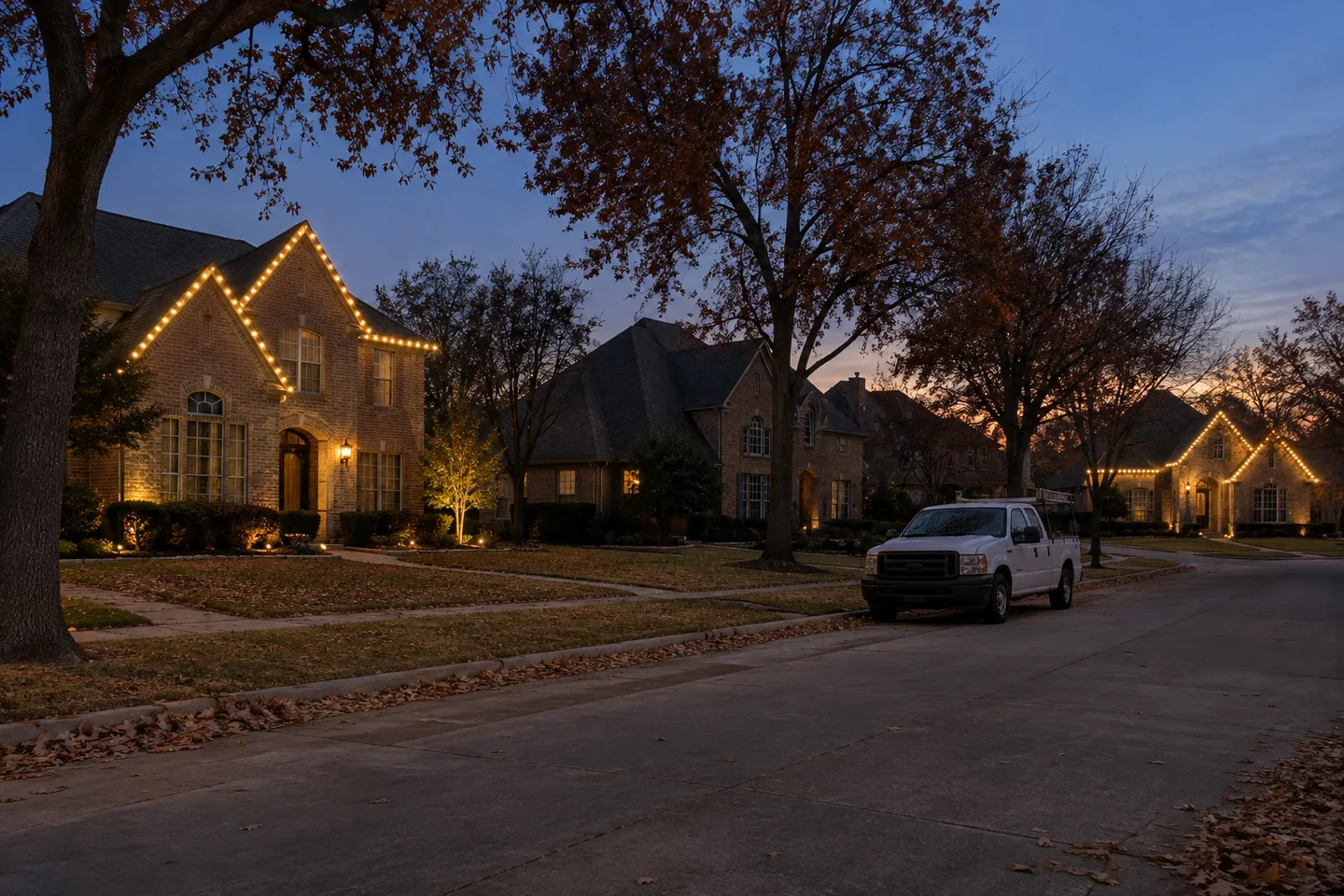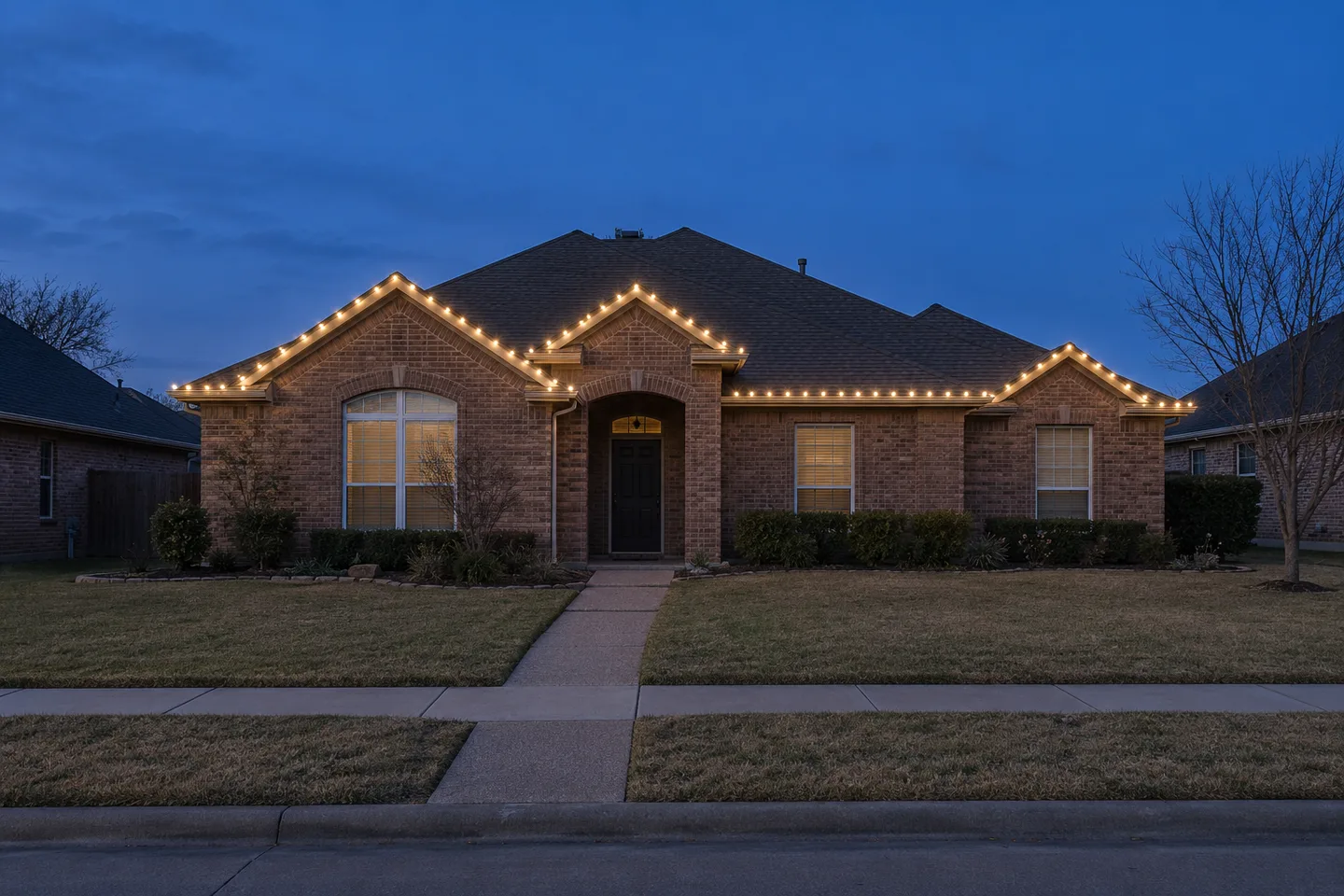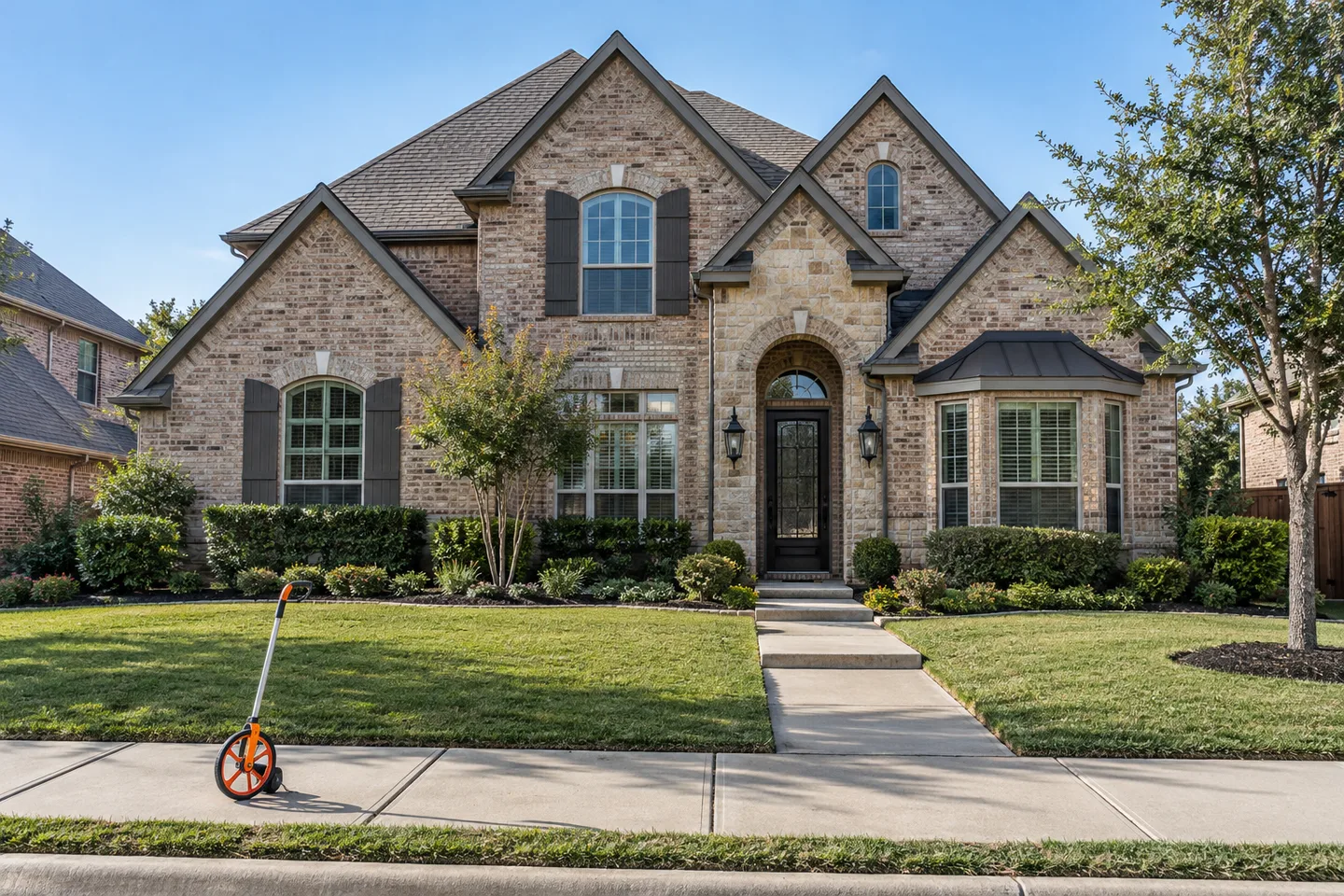
Measure the runs of roofline you actually want lit, not the perimeter of the house. For most DFW homes that means the front eaves plus any gables or peaks facing the street, which on a simple single-story front elevation often lands somewhere around 100 to 150 linear feet, and on a two-story with several gables can easily be double that. Multiply your number by $5 to $8 and you have a roofline budget before anyone comes out.
Here is how to get that number yourself in about fifteen minutes, and the places people usually get it wrong.
Measure What Gets Lit, Not the House
The single most common mistake is measuring the footprint of the house. Lights do not follow the footprint. They follow the edges you choose to light.
Walk to the curb and look at your house the way the street sees it. The lines that read at night are the horizontal eave runs and the angled edges of any gable or peak that faces forward. That is your measurement. The back of the house, the side returns nobody sees, and the garage-side eave that faces a fence are all optional, and most people leave them dark.
So the question is not how big is my house. It is which lines do I want glowing, and how long are they.
The Fifteen Minute Method
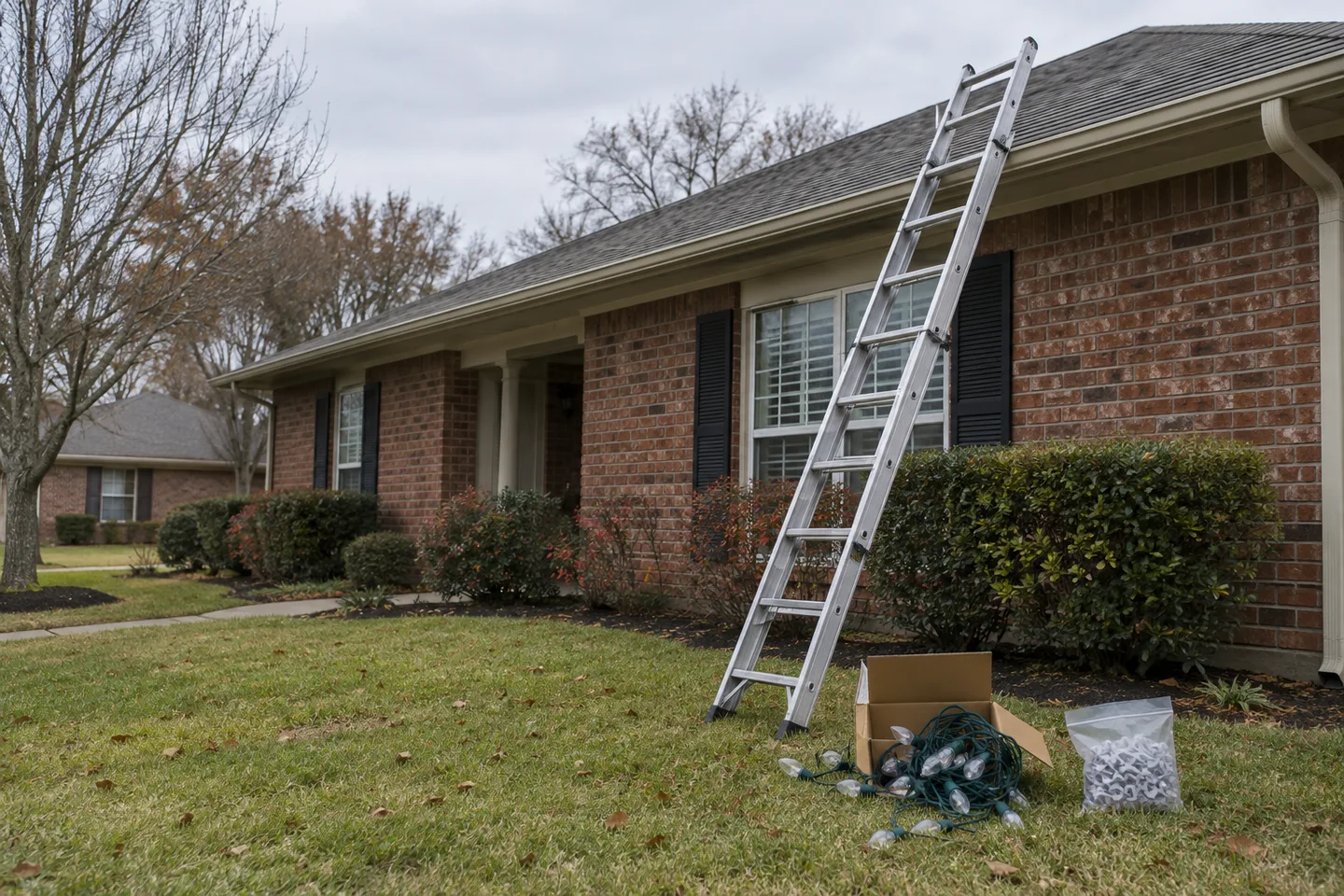
You do not need a ladder for this, which is the point.
- Sketch the front of the house. A rough box with the roof shape on top is enough. You are making a list of runs, not a blueprint.
- Number each run you want lit. Every straight horizontal eave is one run. Every angled gable edge is one run. A simple ranch might have three. A two-story with two gables and a porch roof might have eight.
- Measure each run along the ground. Walk it heel to toe, or use a tape, or pace it if you know your stride. Stand under the eave and measure the ground line directly below it. Horizontal runs measure accurately this way.
- Add about 20 percent to the angled runs. A gable edge is a slope, so the ground measurement under it comes up short. Adding roughly a fifth back gets you close enough for planning.
- Add it all up. That total is your linear feet of roofline.
If you have measured a yard for sod before, this will feel familiar. It is the same discipline of breaking an irregular shape into simple pieces, which we walk through in how much sod do I need.
Turning Feet Into a Number
Christmas light installation is priced per linear foot of roofline, so once you have the footage the arithmetic is straightforward. At $5 to $8 per foot:
| Roofline measured | Roofline budget |
|---|---|
| 100 linear feet | $500 to $800 |
| 150 linear feet | $750 to $1,200 |
| 200 linear feet | $1,000 to $1,600 |
| 300 linear feet | $1,500 to $2,400 |
Those are calculations, not quotes. They are what the math says before anybody has looked at your house.
The spread inside each row is real, and it comes down to how hard the footage is to reach. A long, low, straight eave on a single-story is the cheap end of the range. The same footage broken into eight short runs across multiple pitches on a two-story sits at the top of it, because the crew spends more time moving ladders than hanging lights.
The full breakdown of what moves the number is in what Christmas light installation costs in DFW.
Why Two Story Homes Are Not Just Double
A two-story roofline is not twice the work of a single-story one. It is more, and it is worth understanding why before you compare two quotes.
Everything slows down with height. Taller ladders get repositioned more often, each setup takes longer, and the crew works more carefully because the consequences of not doing so are serious. The footage on the tape might be double. The hours are more than double.
This is also the part of the job that is genuinely worth handing to someone else. There is no arrangement of the numbers where a fall off a two-story roofline in December is cheap.
What the Roofline Measurement Leaves Out
Your linear-foot number covers the roof. It does not cover everything else people end up wanting, and those are quoted separately to scope:
- Tree wraps. Priced per tree, and they vary enormously. A single trunk wrapped to the first branches is a modest add. A full canopy on a mature live oak or pecan, the kind lining the older streets in Carrollton and across the Park Cities, can absorb more material and labor than an entire single-story roofline.
- Columns and garland. Common on porch posts and entryways.
- Wreaths. Usually priced per piece, and placement matters more than count.
- Bed wash and pathway lighting. Ground-level fixtures that graze the landscaping and line the walk.
Most people measure the roofline first, see the number, and then decide how much of the rest they want on top of it. That is a sensible order to do it in.
Use Your Number to Read a Quote
The real payoff of measuring is not the budget. It is that you can tell whether a quote makes sense.
When you have a rough footage in hand, three things become visible. A quote far below your math is usually leaving something out, and the thing most often left out is January takedown, which shows up as a second invoice after the holidays. A quote far above it is either counting footage you did not intend to light or including scope you did not ask for. And a quote given over the phone by someone who never counted your roofline is a guess wearing a number.
Ask what the per-foot rate is, what footage they measured, and whether design, the timer, mid-season service, and takedown are inside the price or outside it. Our number includes all six, which is the comparison that matters when two quotes look different.
Let Us Measure It For Real
Your fifteen-minute estimate is genuinely useful for planning. It is not a quote, and we would not pretend it is.
We come out, measure the roofline properly, look at the trees and the beds, design the scene with you, and leave you with a fixed price. If it works, we reserve your install date. If your own number and ours are close, that is a good sign you have been talking to honest people.
Get a free on-site measure and quote, or see everything that goes into a design on our Christmas light installation page. Install dates fill up as the season gets closer, so if you want lights before Thanksgiving, book early in the fall. We take bookings through December 15.