If you have a single-story home with walkable eaves, a helper to foot the ladder, and a Saturday afternoon, hanging your own Christmas lights is a reasonable call and plenty of DFW homeowners do it well. If you have a two-story roofline, a steep pitch, gables over a driveway or a pool, or mature trees you want wrapped, hire it out: the ladder work at that height is the part of the job that is genuinely dangerous, and it is the part a professional price is mostly paying for. For a typical 150-foot roofline, DIY materials run roughly $200 to $500 at retail before a ladder, and a professional install runs $750 to $1,200 with design, commercial LED C9 lights, a timer, one service visit, and January takedown inside the price.
Here is how to decide, and what each path actually costs.
When DIY Makes Sense
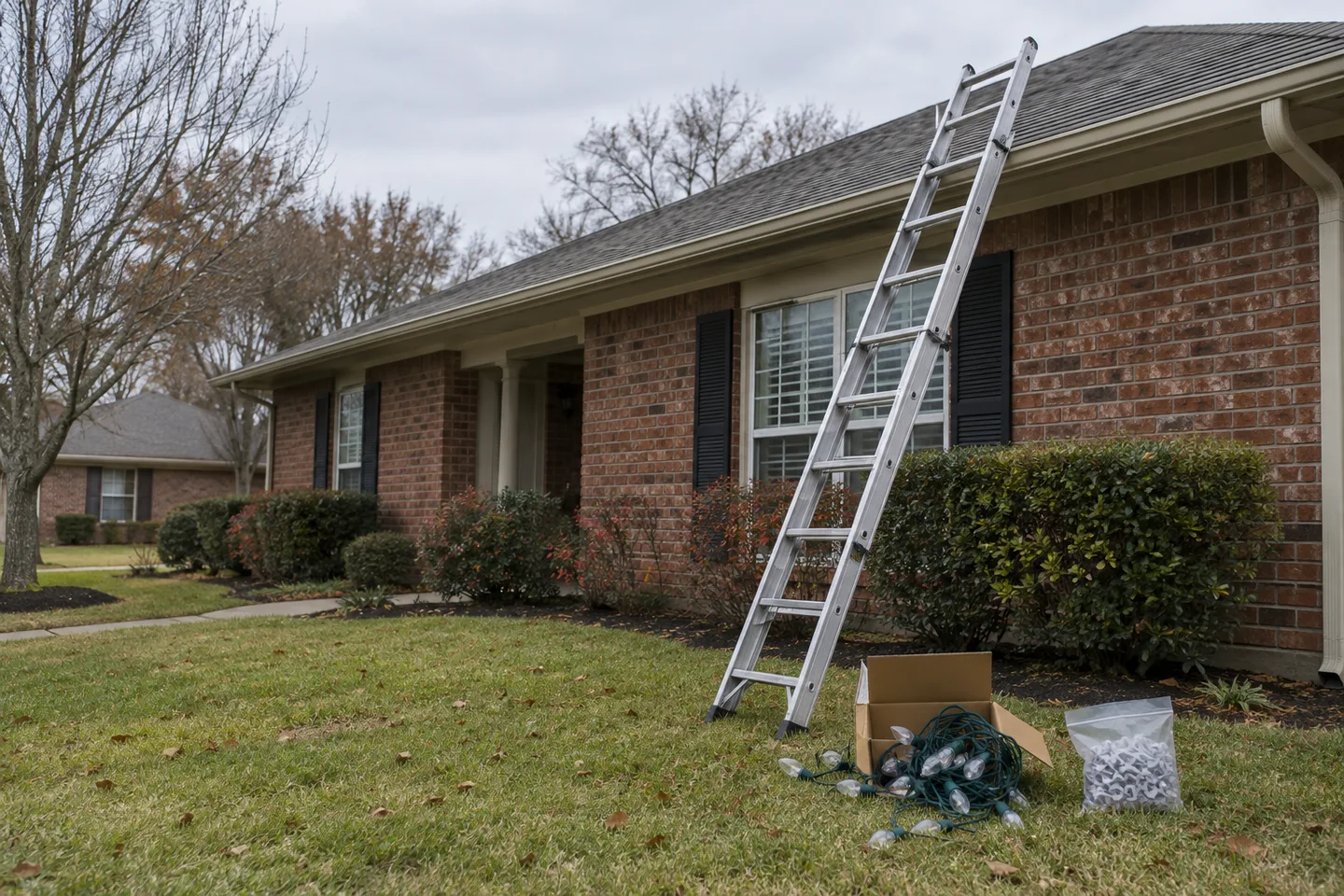
The DIY case is a single-story house. Ranch homes in older Carrollton, Farmers Branch, and Addison, the 1970s and 80s builds with long low eaves, are the ideal case: the roof edge is eight to ten feet up, a short extension ladder reaches it, and you can work a straight run without repositioning much.
You also need a helper, not for the hanging but for the ladder. A second person footing the ladder and handing up strands turns a sketchy afternoon into a safe one. If that describes your house and your Saturday, go for it. If it does not, the next section is the one that matters.
When to Hire It Out
Two-story rooflines are the line. Most of north DFW's newer housing stock is two-story: Castle Hills, Hebron Valley, Phillips Creek Ranch, Stonebriar, the Coppell subdivisions off Sandy Lake. The roof edge on those homes is 18 to 24 feet up, and the gables go higher.
Working at that height means a 24- or 28-foot extension ladder, set on a sloped driveway or a flower bed, in December, often with a north wind. The ladder gets repositioned every ten to fifteen feet of roofline, each setup is a chance to get it wrong, and a fall from a second-story eave is not a sprained ankle. Professional crews do this with the right ladders, standoffs, and a second person on the ground, and it is still the slowest, most careful part of their work.
Add to the two-story rule: steep pitches where the gutter line is hard to reach, rooflines over a pool or a steep driveway where the ladder base has nowhere level to sit, and mature live oaks or pecans you want wrapped, because a full canopy wrap is a tree-climbing job, not a ladder job. If any of that is your house, hire it. There is no arrangement of the numbers where a fall is cheap.
Ladder Safety on a Two-Story DFW Home
If you are going to do a two-story anyway, do it right. Use an extension ladder rated for your weight plus tools, set at a four-to-one angle: for every four feet of height, the base sits one foot out from the wall. On a sloped driveway, use a leveler or move to level ground, never a stack of pavers. A standoff keeps the rails off the gutter. Never stand on the top three rungs, never lean out past your belt buckle, and move the ladder instead of reaching, with a second person on the ground the entire time.
Check the weather. Wet shingles and a wet ladder in a December cold front are the wrong combination, and the ice storms that hit DFW most years are not the week to be on the roof.
Clips, Not Staples
The second most common DIY mistake after the ladder is attaching the lights.
Staples and nails go through the cord insulation, into the shingle or fascia, and leave holes that let water in. They also make takedown a tearing job that damages the cord and the house. Do not use them.
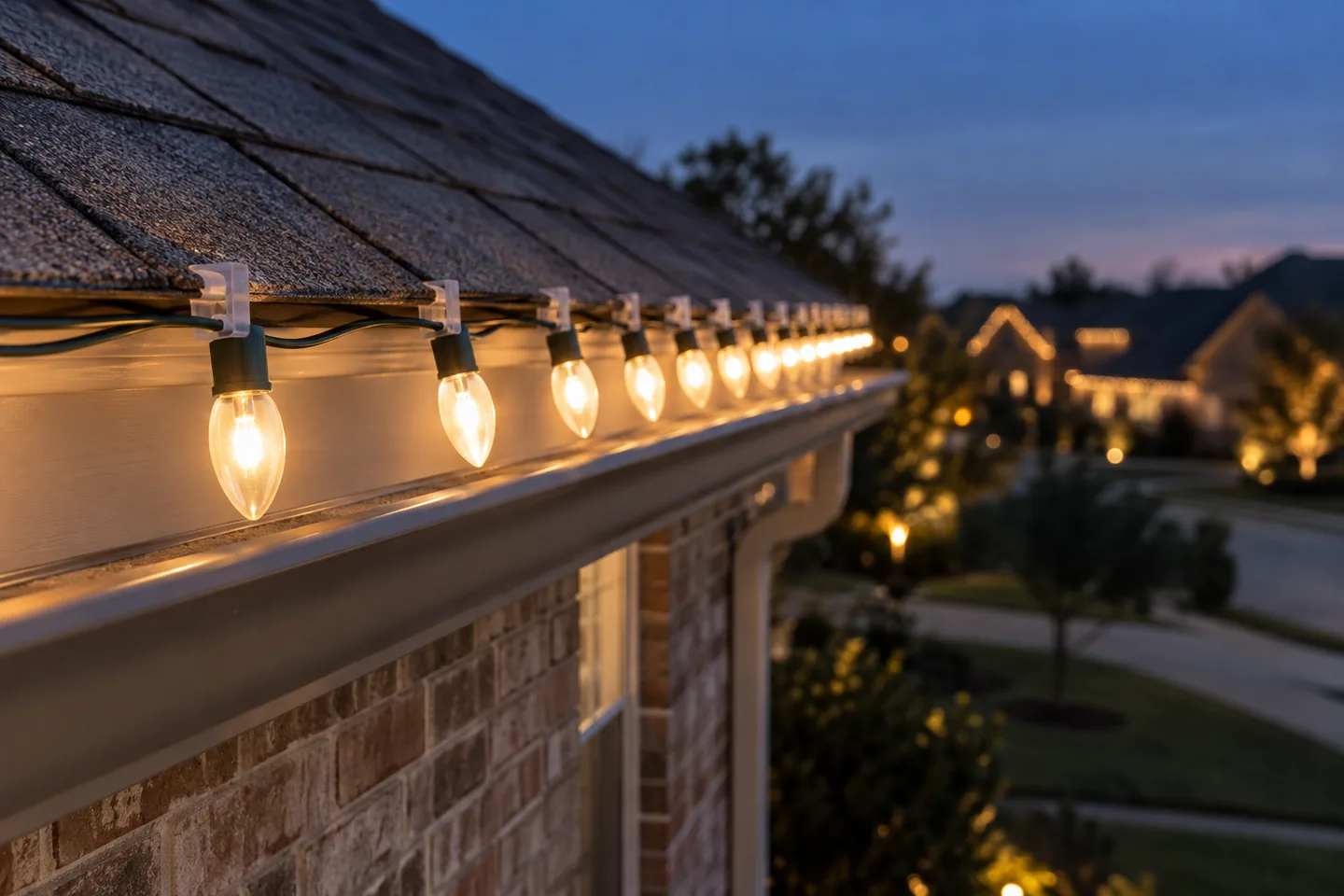
Use shingle clips or gutter clips designed for C9 and C7 bulbs. They slide under the shingle edge or over the gutter lip, hold every bulb pointing the same direction, and come off clean in January. One clip per bulb on a 12-inch spacing gives you a straight line from the curb; skipping clips is how a display ends up sagging.
GFCI, Rain, and Timers
Your exterior outlets are GFCI-protected by code, and they trip when current leaks to ground, which is exactly what happens when water gets into a plug connection. The December rain that soaks DFW a few times a season is the usual cause of a display that goes dark and will not reset.
Keep every plug-to-plug connection and splice off the ground, ideally under an eave, and cover each one. Use outdoor-rated cords only, and do not daisy-chain more strands than the first strand's rating allows. If the outlet will not reset after everything dries, the problem is a damaged cord or a cracked socket, not the outlet.
Buy a timer. A dusk-to-dawn outdoor timer or photocell plug costs very little and means you are not walking to the garage every evening.
Measure Before You Buy
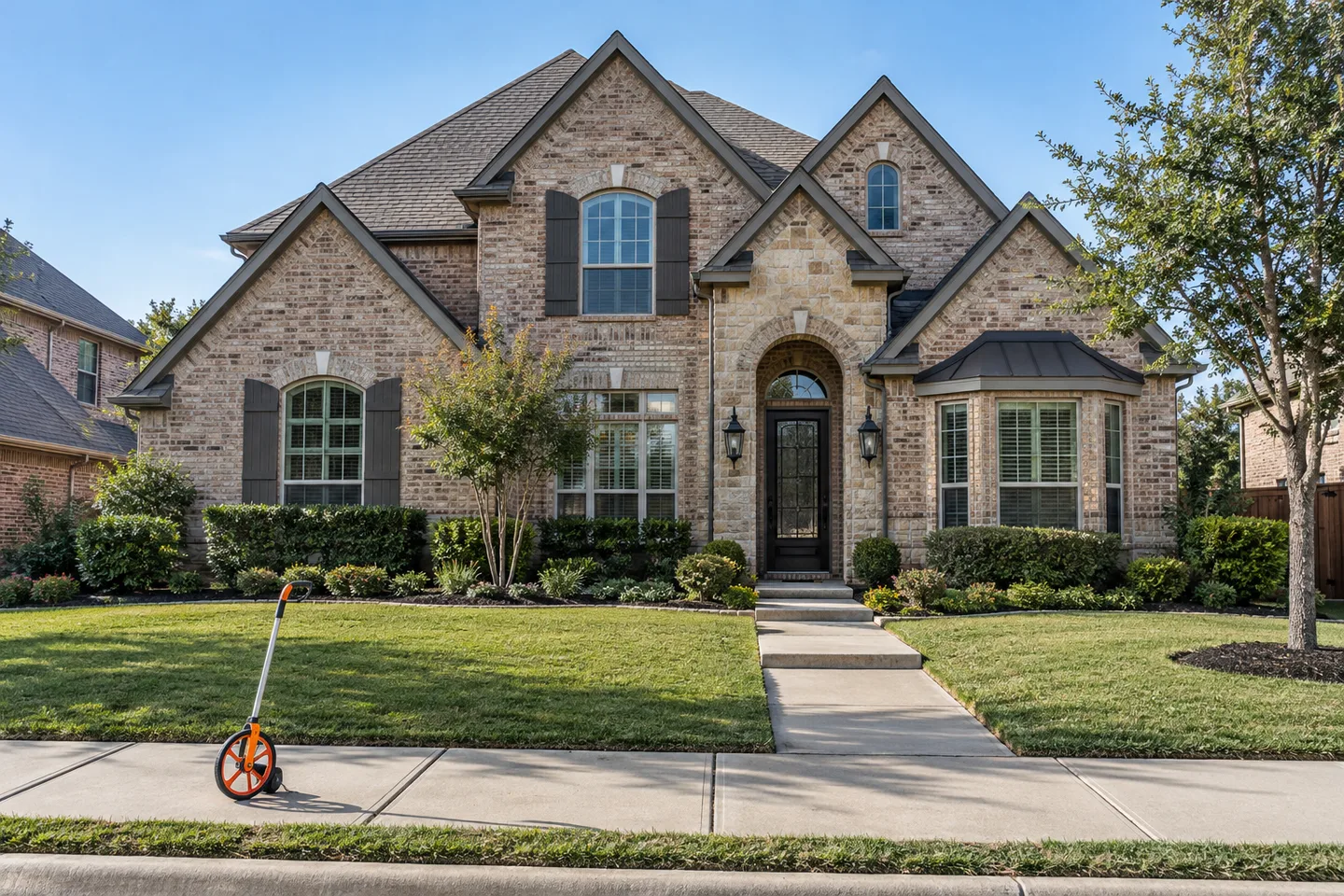
Do not measure the house. Measure the runs you want lit: the front eaves and any gable edges that face the street, adding about 20 percent to the angled runs because the ground measurement under a gable comes up short. The full fifteen-minute method is in how many feet of Christmas lights a house needs. Most single-story front elevations land around 100 to 150 feet. Buy ten percent more than you measured, because running one strand short on a Saturday evening is the classic DIY ending.
What DIY Actually Costs for a 150-Foot Roofline
These are retail estimates from typical big-box and online pricing in the fall, and they move around. They are also materials only, with your labor at zero.
| Item | Retail estimate |
|---|---|
| Consumer boxed LED strands to cover 150 ft | $120 to $250 |
| Or: C9 LED bulbs on bulk commercial cord, 150 ft | $300 to $500 |
| Shingle or gutter clips (about 150) | $20 to $40 |
| Outdoor timer or photocell plug | $20 to $40 |
| Outdoor-rated extension cords | $30 to $60 |
| 24 ft extension ladder, if you do not own one | $200 to $400 |
So a single-story DIY with boxed strands and a ladder you already own is around $200 to $400 in materials. Commercial-grade C9 on bulk cord, which is what lasts and looks straight, is closer to $400 to $650. Add a ladder and a two-story job is pushing $600 to $1,000 before you have climbed anything. The boxed strands are cheaper this year and are the ones that come out of the attic next November with a dead section.
What a Professional Price Buys
For the same 150-foot roofline, a professional install runs about $750 to $1,200 at $5 to $8 per foot. A two-story roofline of 180 to 220 feet runs about $900 to $1,760. Trees and accents are quoted on top. Those are planning ranges; the number is set after an on-site measure.
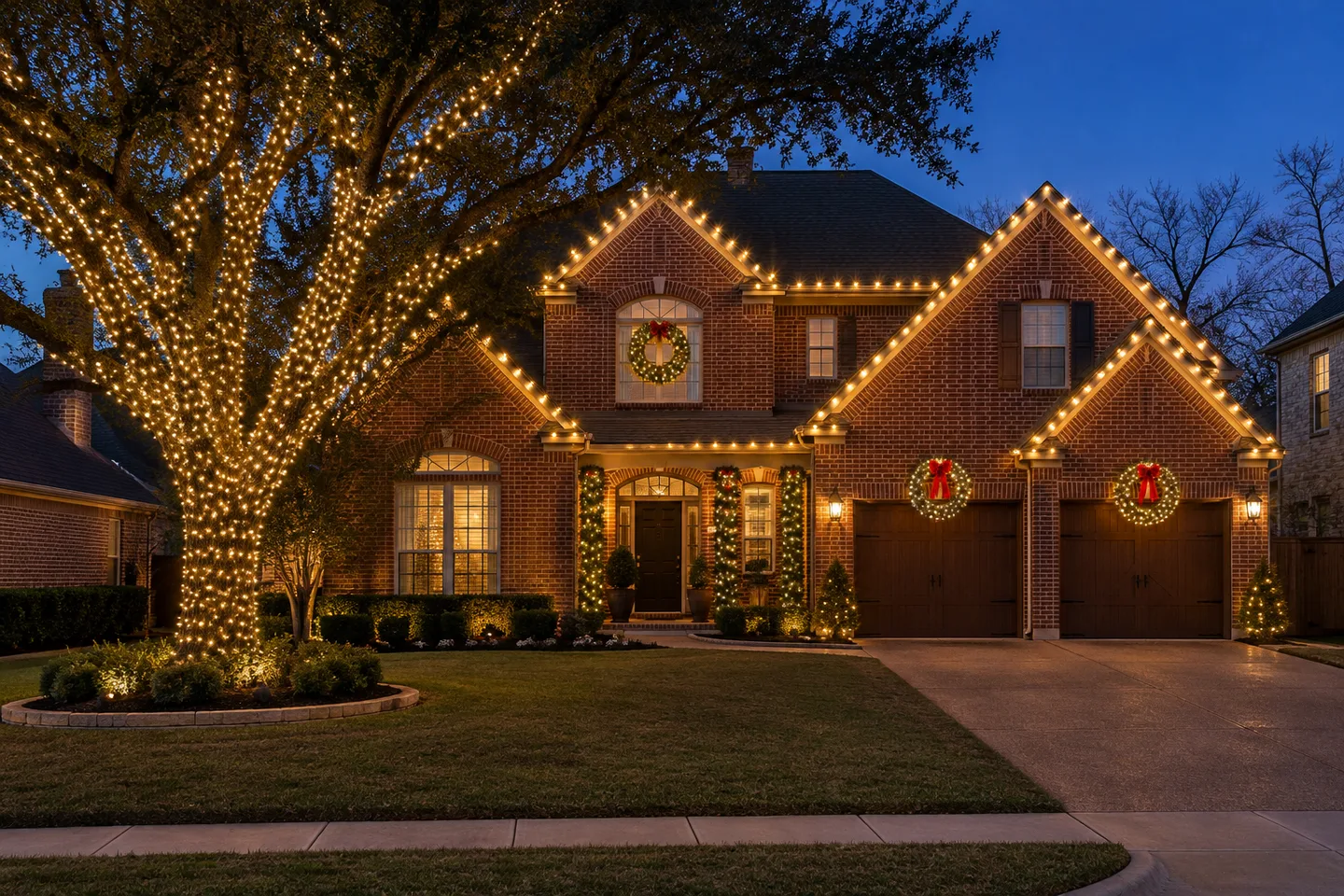
What is inside that price: the design walk and measurement, commercial-grade LED C9 bulbs on heavier-gauge cord, hidden clips, the install at whatever height your roof is, a dusk-to-dawn timer, one mid-season service visit if a string or bulb fails before Christmas, and January takedown. After takedown the lights, clips, and timer are yours to keep, so the second season is cheaper than the first.
What is not inside it: off-season storage (the boxed lights stay at your home; we do not warehouse them), storm damage (re-hung as a separately quoted visit), and permanent lighting systems, which we do not install. The full breakdown of what moves a quote is in what changes a Christmas lighting quote beyond roofline length.
The Decision
Single-story, walkable eaves, a helper, and a free Saturday: do it yourself, use clips, keep the connections dry, and buy a timer. Two-story, steep pitch, bad ladder footing, or mature trees you want wrapped: hire it out. The price is mostly paying for someone else to be on the 28-foot ladder in a north wind, and that is a good trade.
If you are the second homeowner, the ranges by home type and everything included are on our Christmas light installation page. We install across Carrollton, Plano, Frisco, and the rest of north DFW, and we book through December 15. October fills the calendar, so if you want lights before Thanksgiving, that is the month to call.