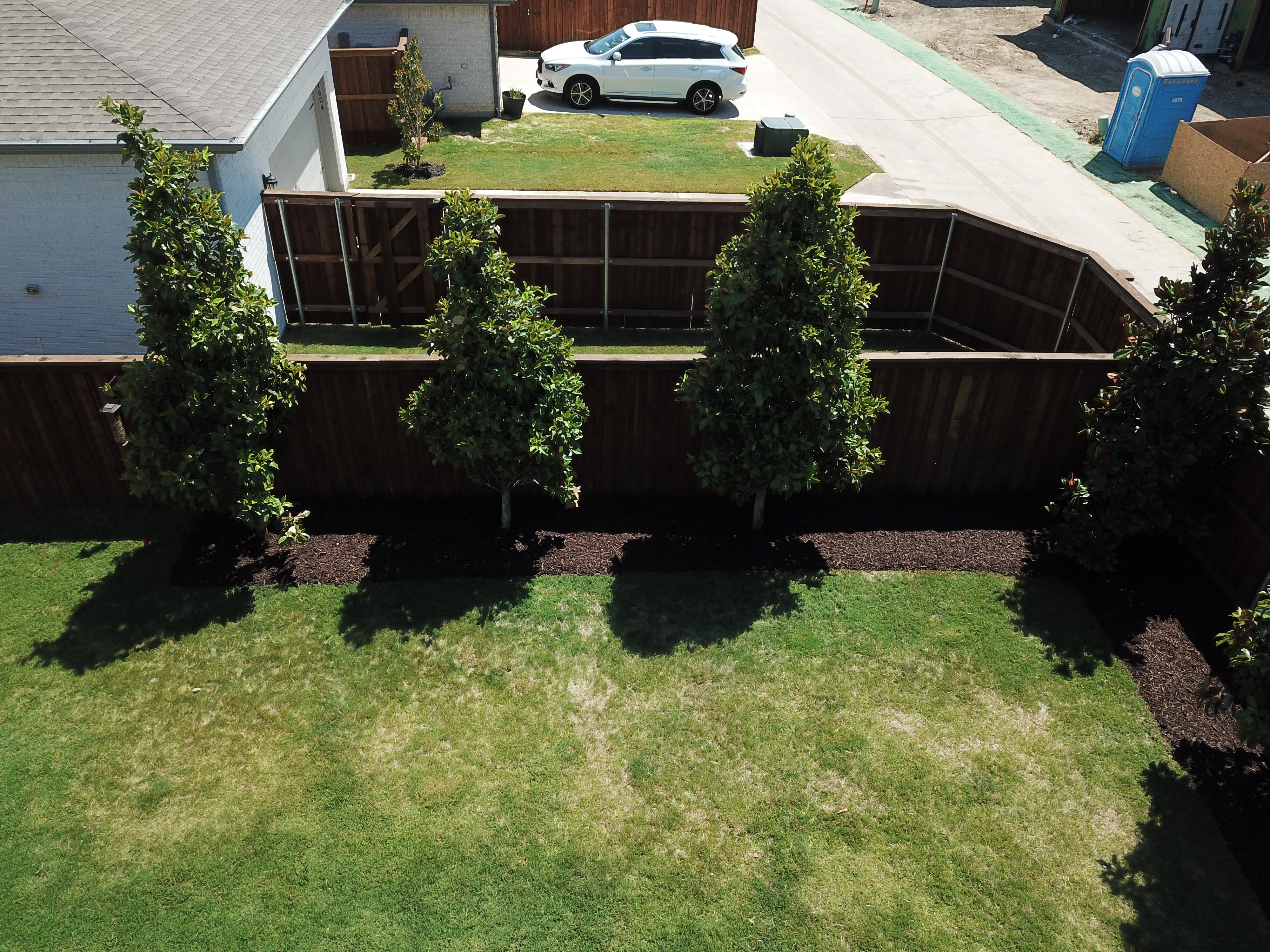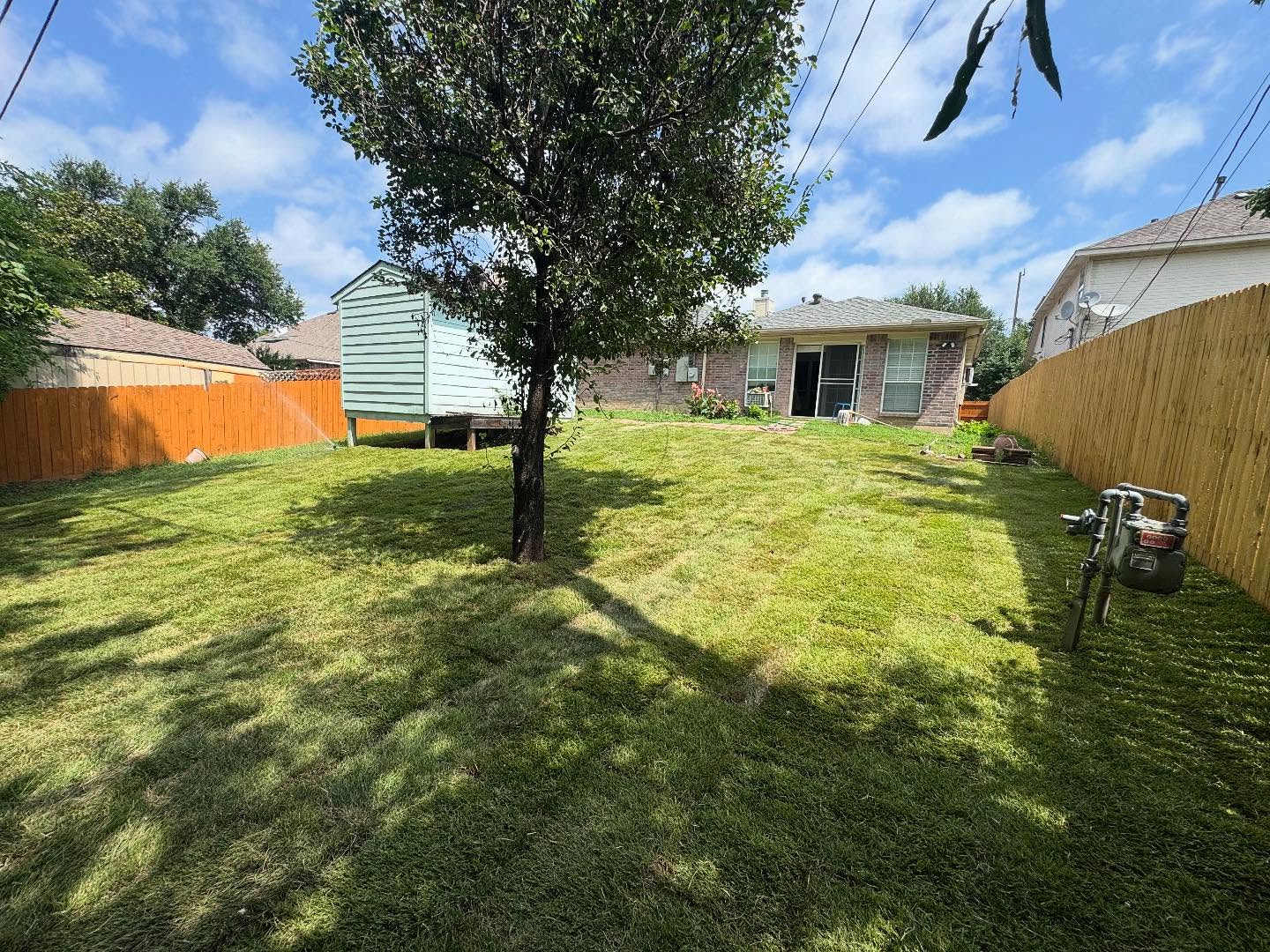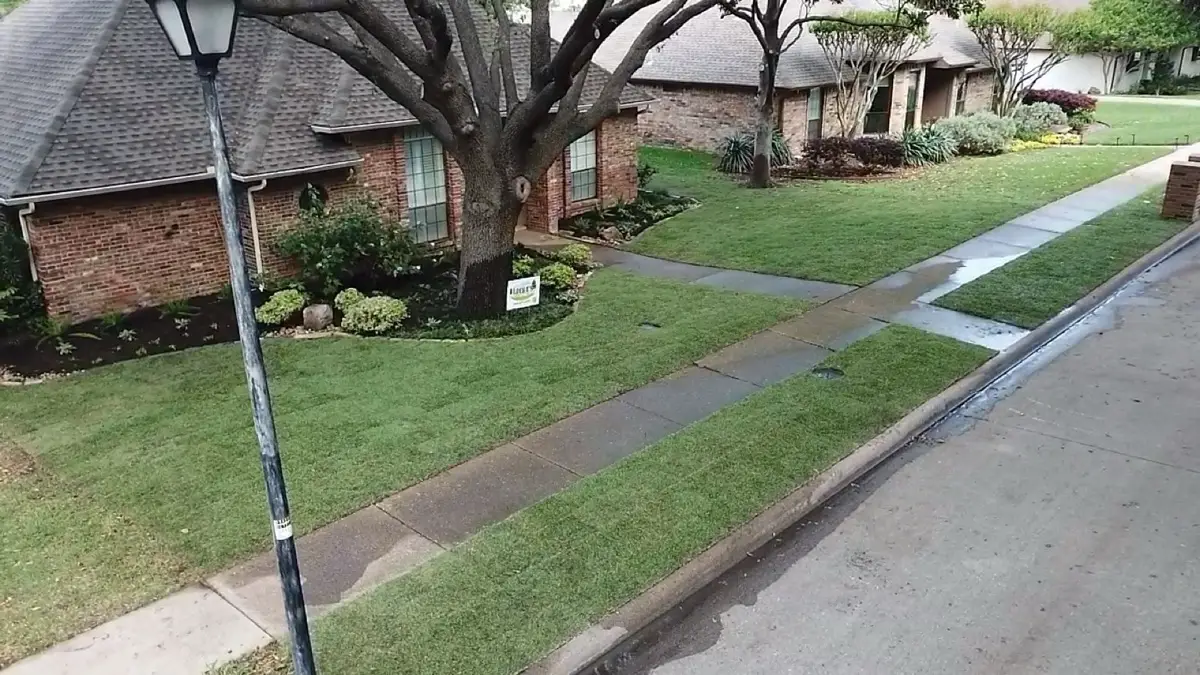
Neither one wins outright, and the honest deciding factor is shade. If the area gets less than about four hours of direct sun, St. Augustine is the only one of the two that will actually live there. If it gets five or more hours, Palisades Zoysia is the better long-term North Texas lawn: it uses less water on a twice-a-week schedule, takes foot traffic far better, gets hit by fewer insects, and survives our cold snaps with less drama.
That is the short version. The longer version matters, because we are the crew that comes back in year three to replace the lawn that was picked wrong, and the pattern is consistent enough that we can usually guess which grass a struggling yard has before we pull in the driveway.
Zoysia vs St. Augustine at a glance
| Factor | Zoysia | St. Augustine |
|---|---|---|
| Minimum sun | About 4 to 6 hours, takes part shade | About 4 hours, the best true-shade grass |
| Feel | Fine to medium, dense | Broad and spongy |
| Water use | Lower | Higher |
| Main disease and pests | Large patch | Brown patch, take-all root rot, chinch bugs |
| Cold tolerance | Better | Weaker, cultivar matters |
| Mowing | Lower, moderate | Higher, 3 to 4 inches |
| Traffic, kids, dogs | Better | Softer, wears faster |
| Best for | Sun to part shade, durability | Deep shade under trees |
Start With the Sun, Not the Catalog
Before anything else, go stand in the yard at 10 a.m., again at 1 p.m., and again at 4 p.m., and note which parts are in direct sun each time. That is the whole decision.
- Under 4 hours of direct sun: St. Augustine, and really only St. Augustine. It is the most shade-tolerant warm-season grass we can grow here.
- 4 to 6 hours: the genuine gray zone. Palisades Zoysia is bred for exactly this and usually holds, but a north-facing yard under a dense pecan canopy can still be St. Augustine territory.
- 6-plus hours: Zoysia comfortably, and honestly Bermuda deserves a look too, since it costs less and takes more abuse. We laid out all three in Bermuda vs Zoysia vs St. Augustine.
The mistake we see most often is treating a yard as one thing. A typical Carrollton or northwest Dallas lot with a mature live oak out front is genuinely two different growing environments, and the right answer is sometimes two different grasses with a bed line between them. There is more on the shade side in our best grass for shade in North Texas post.
Water Use Under a Twice-a-Week Schedule
Most of the metro runs a twice-a-week watering schedule on days assigned by your address, and that constraint changes the math in a way a general grass guide will not tell you.
St. Augustine has the highest water demand of the warm-season grasses we plant here. Its roots stay relatively shallow, and it wilts and browns faster than Zoysia when it misses water. On two days a week in a real August, a St. Augustine lawn in full sun is living right at its limit, and any weak spot in your sprinkler coverage shows up as a dead patch by Labor Day.
Zoysia roots deeper and handles a dry stretch by slowing down and going off-color rather than dying. That is exactly the behavior you want when the city tells you which two days you get. Palisades in particular holds green longer between cycles than St. Augustine on the same schedule.
The flip side: Zoysia is slow. It is slow to establish after we lay it and slow to fill in a damaged area. St. Augustine spreads aggressively by above-ground runners and repairs itself, which is a real advantage if you have dogs, kids, or a section that gets torn up.
The Named Problems: Brown Patch, Take-All, and Chinch Bugs
This is where St. Augustine costs you, and it is the part sod suppliers tend to skip.
Brown patch hits both, and it fires when nights cool into the 60s and 70s while the soil is still warm, so mid-September through November and again in a wet spring. On St. Augustine it makes circles where the blades pull free from a rotted sheath. On Zoysia it is called large patch and the damage is similar, but Zoysia's slow growth means those circles sit there looking terrible for months instead of filling in.
Take-all root rot is primarily a St. Augustine problem here. The fungus infects the roots in cool wet spring weather, then the lawn collapses in July when the crippled roots cannot keep up with the heat. By the time you see it, spraying mostly does not help.
Chinch bugs are the St. Augustine-specific pest, and Zoysia essentially does not get them. Southern chinch bugs work the hot, sunny, dry edges of a lawn, along the driveway and the south-facing strip by the sidewalk, in exactly the stretch you would blame on the sprinklers. Every summer we look at St. Augustine lawns where the homeowner has been watering a chinch bug problem for a month. If you are trying to sort out which of these you are looking at, we walked through it in does my lawn have a fungus, or is it just the heat.
Add it up and a St. Augustine lawn in DFW is a lawn you manage. That is a fair trade for shade you cannot get any other way. It is a bad trade if you had a choice and picked it for looks.
Cold Snaps, and Why the Cultivar Matters
DFW sits at the northern edge of where St. Augustine can be grown at all, and that is not a small footnote. A hard multi-day freeze can kill St. Augustine outright, and North Texas has seen exactly that in living memory. Zoysia and Bermuda both go dormant and come back.
If you plant St. Augustine here, the cultivar is not a detail. Raleigh is the cold-hardy St. Augustine selected for the northern part of the range, and it is what belongs on a North Texas yard. Floratam, which you will see referenced in plenty of general St. Augustine advice online, was developed for Florida and Gulf Coast conditions and is notably freeze-sensitive, which makes it a poor bet this far north. Ask any supplier which cultivar you are actually buying, and if nobody can tell you, that is an answer in itself.
On the Zoysia side, Palisades is the workhorse for DFW yards: coarser blade, better shade tolerance than most, good heat performance. Zeon is the finer, plusher option. We compared them directly in Zeon vs Palisades Zoysia.
Mowing and Day-to-Day Upkeep
St. Augustine wants to be mowed high, in the 3 to 4 inch range, and it grows fast enough in spring that you will be out there weekly. The blade is coarse and the runners are thick, so a dull mower blade shreds it and leaves the lawn looking gray.
Zoysia grows more slowly, so you mow less often, which is the trade people actually notice. The catch is that Zoysia is dense and tough on equipment. A homeowner mower with a sharp blade handles it fine, a dull one struggles. Zoysia also builds thatch faster, so it benefits from periodic dethatching or aeration in a way St. Augustine needs less.
Neither one is low-maintenance the way people mean it. Both are heavy feeders and both do better on a real schedule than on random trips to the fertilizer aisle.
What Blackland Clay Does to Both of Them
Carrollton, Farmers Branch, Addison, and most of northwest Dallas sit on Houston Black clay, the heavy expansive Blackland Prairie soil. It swells when it rains, shrinks and cracks in a Texas summer, and drains slowly.
Two consequences. First, that slow drainage keeps the canopy damp longer, which raises disease pressure on both grasses and hits St. Augustine hardest. Second, and this is the one that decides whether an install lives: sod laid on ungraded, compacted clay never roots properly, no matter which grass you chose. The soil moving underneath tears the lawn apart from below.
This is why we grade for drainage and amend the soil before anything goes down, and it is the single biggest difference between a lawn that survives August and one you are replacing in two years. The full walkthrough is in preparing soil for sod on North Texas clay.
Replacing a Failing St. Augustine Lawn
A good share of our sod work is exactly this: a St. Augustine lawn that got thinned out by chinch bugs, take-all, a freeze, or a combination, and the homeowner is deciding whether to nurse it or start over.
The first honest question is why it failed. If the yard is genuinely too shady for anything else, replacing St. Augustine with St. Augustine is the right call and the real fix is drainage, watering timing, and pest management. If the lawn is in decent sun and just got managed into the ground, switching that area to Palisades Zoysia usually ends the cycle.
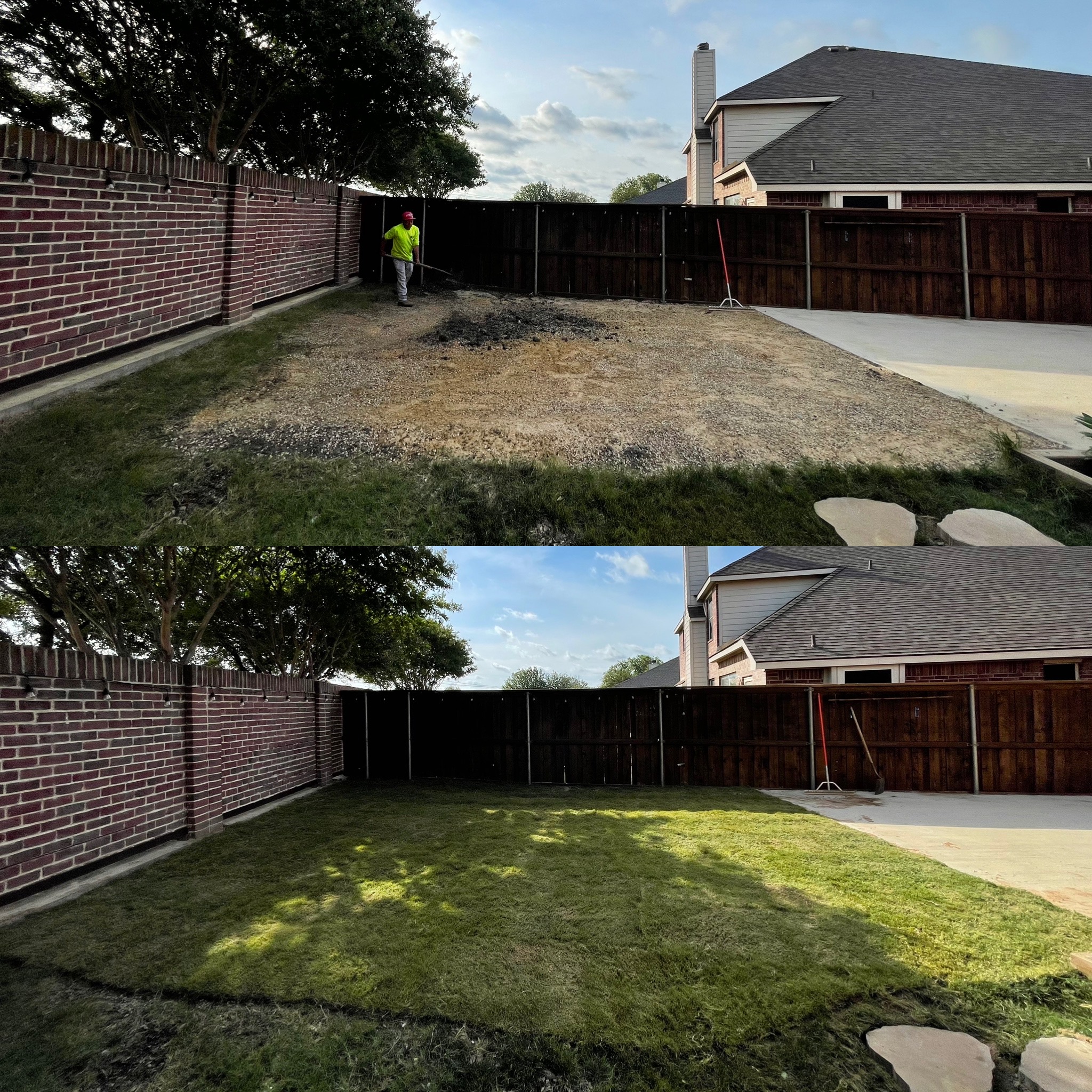
What a replacement involves: we walk the property and measure, strip and haul away the old turf, re-grade so water actually leaves the yard, amend the soil where the clay needs it, lay fresh sod, and hand you a written 30-day watering schedule matched to your sprinklers and your city's assigned days. Most residential jobs finish in one day. New sod qualifies for a 30-day watering variance in most DFW cities, and we register the install when it is needed.
On price, we quote after a free on-site measure rather than over the phone, because square footage, how much old turf has to come out, and how much grading the lot needs all move the number more than the grass choice does. Timing matters too: late March through May is the sweet spot, with early fall a solid second window, which we cover in the best time to lay sod in North Texas.
Common questions
Which one needs less water? Zoysia. It roots deep and holds color on less water, which matters under a twice-a-week summer schedule. St. Augustine is the thirstier of the two.
Which survives real shade? St. Augustine. It is the best shade grass we install. Zoysia takes part shade but needs more sun than St. Augustine to stay dense.
Is St. Augustine high-maintenance? It is the more disease- and pest-prone of the two, with brown patch, take-all root rot, and chinch bugs all on the watch list, and it needs more water. It is worth it when the shade leaves you no better option.
Which handles cold better? Zoysia. St. Augustine is the more freeze-sensitive of the two, and the cultivar matters in a hard North Texas winter.
Can I replace a failing St. Augustine lawn with Zoysia? Yes, if the spot now gets enough sun. If it is still deep shade under mature trees, St. Augustine is usually still the realistic choice, and we will tell you so.
The Short Answer, One More Time
Shade decides it. Deep shade means St. Augustine and a plan for managing it. Decent sun means Palisades Zoysia will give you a tougher lawn that drinks less and asks for less. And if the yard is split, the right answer may genuinely be both.
If you want someone to actually walk your yard and watch how the sun moves across it, we do that as part of a free sod estimate. We work Carrollton, Farmers Branch, Addison, and northwest Dallas most weeks, and we have laid and replaced both grasses across the metroplex since 2010. Yard-specific reading for our home base is in the best grass for a Carrollton yard, and for the tree-heavy Dallas neighborhoods on our Dallas sod installation page.
This article is part of The Complete Guide to Sod Installation in DFW, our full walkthrough of choosing, installing, and caring for sod in North Texas.