Heat and water stress show up uniformly and follow your sprinkler pattern, and the blades stay firmly rooted when you tug them. Fungus makes defined circles or irregular patches with a distinct edge, and those patches visibly grow day over day while infected blades pull free from the crown with almost no resistance. Check the lawn at dawn, before the sun burns off the dew and hides the evidence, and you will usually know within five minutes which one you are dealing with.
We get this call every year, and it doubles once the September nights start cooling off. Here is how we tell the difference on a DFW lawn, what actually shows up on our grasses, and what to do about it this week.
Fungus or Heat? The Fast Test
Walk the yard at dawn with your phone. Three things separate the two:
- Shape and edge. Heat and drought stress is fuzzy and follows something physical: the strip along the driveway, the south-facing slope, the spot the sprinkler head misses, the high spot over a buried rock. Fungus draws a shape that has nothing to do with any of that. Brown patch makes rings and circles with a defined outer edge, sometimes with a darker smoky border in the morning. Take-all root rot makes irregular yellow blotches that wander.
- The tug test. Grab a handful of grass at the edge of the bad area and pull straight up gently. Healthy heat-stressed grass holds on: the blades tear before the plant lets go. If blades slide out of the sheath easily, or if whole runners lift with short blackened roots hanging off them, that is disease, not thirst.
- Speed. A heat-stressed lawn looks about the same today as it did four days ago. A fungus patch that was the size of a dinner plate on Monday is the size of a trash can lid by Friday, and you can see the outline moved.
One more tell. Heat and water stress leaves footprints. Walk across a dry lawn in the late afternoon and your tracks stay pressed down instead of springing back, because the blades do not have enough water in them to stand up. That is a thirsty lawn, and no fungicide will help it. If you are seeing brown next to green with the sprinklers running fine, our post on why a lawn browns while the sprinklers run walks the irrigation side of it.
The Three Lawn Diseases That Actually Show Up in DFW
Most of what people call "lawn fungus" here is one of three things.
Brown patch, also called large patch. Caused by Rhizoctonia, and this is the big one in North Texas. It fires when night temperatures drop into the 60s and 70s while the soil is still warm and the leaf stays wet for long stretches, which means roughly mid-September through November, and again in a wet spring around March through May. It is not a hot-weather disease, which is exactly why people get it wrong. It makes roughly circular tan or straw-colored patches, a foot to several feet across, that can merge into big irregular blobs. The classic confirmation: pull a yellowing blade at the edge and the base of it is dark, rotted, and slips right out of the sheath. The roots are usually fine. The lawn is not dead, it is losing leaves.
Gray leaf spot. This one is a genuine hot-and-humid-weather disease, mostly June through September, and it mostly goes after St. Augustine. Look at an individual blade instead of the patch. You will see small oblong lesions, gray or tan in the middle with a dark purple-brown border, and enough of them will make the whole lawn look scorched or ashy from a distance. Heavy nitrogen and long leaf wetness both make it worse, which is why it shows up on the lawn that just got fertilized and watered every night.
Take-all root rot. The sneakiest of the three. The fungus infects roots during cool, wet spring weather, then the damage only becomes visible when summer heat arrives and the crippled root system cannot keep up. So you see it in July and August but the problem started in April. It shows as irregular yellowing patches that thin out and do not respond to more water. Dig or peel up a runner: the roots are short, dark, and rotted instead of white and fibrous, and the stolons lift off the soil with no resistance. This is the one where a fungicide sprayed in August mostly wastes your money, because the roots are already gone. The fix is cultural and slow.
What It Looks Like on Bermuda vs. Zoysia vs. St. Augustine
Grass type changes the odds more than anything else.
Common Bermuda. The most disease-resistant of the three here, and the most likely to just be heat. Bermuda goes tan across a whole area in a hot dry stretch and greens back up after rain, which is dormancy, not death. When Bermuda genuinely thins out in DFW, the cause is usually shade, compaction, traffic, or a coverage gap before it is fungus. The disease that does hit Bermuda is take-all root rot, and it looks like patches that yellow and thin through the summer heat while everything around them stays fine.
Palisades Zoysia. Zoysia grows dense and builds thatch, and that thick canopy holds moisture right where the fungus wants it. Palisades is the one we most often see with fall large patch: clean circles that appear in October, look terrible, and then sit there, because Zoysia grows slowly and is very slow to fill back in. That slow recovery is the reason prevention matters more on Zoysia than on anything else. If you are still deciding between cultivars, we compared them in Zeon vs Palisades Zoysia.
Raleigh St. Augustine. The most disease-prone of the three in North Texas, and it gets all three of the above. Part of that is genetics and part of it is where we plant it: Raleigh goes in the shady spots under mature live oaks and pecans, exactly the places with still air and slow drying, which is the environment fungus wants. On St. Augustine the pull test is the most reliable, because brown patch leaves that rotted, slimy blade base that slides right out. If your yard is a shade lawn in Farmers Branch or the older parts of Carrollton, expect to manage disease as a normal part of owning it.
Why Blackland Clay and Twice-a-Week Watering Make It Worse
We sit on the Blackland Prairie, and the base soil across Carrollton, Farmers Branch, Addison, and much of Dallas is Houston Black clay. It is heavy, it drains slowly, and it swells and cracks with the seasons. Water that would soak away in a sandy soil sits at the surface here, which means the crown of the plant and the bottom inch of the canopy stay damp longer than they should. Long leaf wetness is the single biggest driver of brown patch, and our soil hands it to the fungus for free.
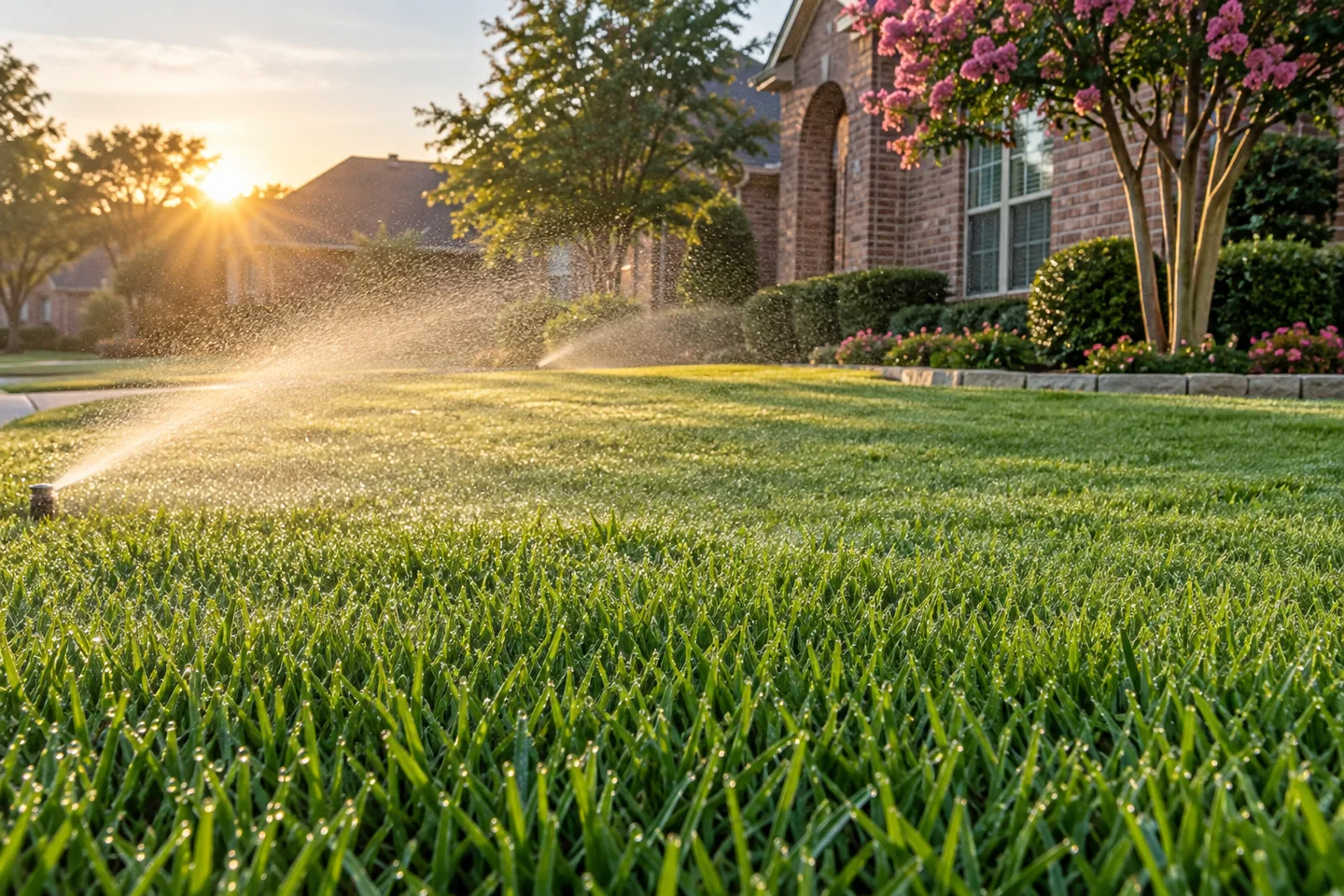
Then the watering schedule pushes in the same direction. Most of the metro is on a twice-a-week schedule, so people compensate by running long cycles on their two allowed days. That is the right instinct. The problem is when they run at 9 p.m. because it is convenient. A lawn watered at night stays wet from dusk until the sun dries it the next morning, which can be twelve hours of leaf wetness on top of the dew. Do the same watering pre-dawn instead, roughly 4 to 6 a.m., and the grass is already damp with dew, so you add almost no extra wet hours and it dries by mid-morning. Same water, same schedule, far less disease pressure. There is more on getting the runtimes right in our sprinkler settings for Texas summer post.
The other clay-specific factor is drainage. If a patch of your yard is where the water always ponds after a storm, that is where the disease will start every single year. Sometimes the honest fix is grading and drainage, not chemicals.
What to Do This Week, and What Not to Do
If you have found real fungus:
- Move watering to pre-dawn. Free, immediate, and the single highest-value change you can make.
- Raise the mowing height. Taller grass shades its own roots and handles stress better. Never take off more than a third of the blade at once, and stop scalping a stressed lawn.
- Do not push nitrogen into an active brown patch. This is the most common mistake we see. Nitrogen tells the plant to grow soft, lush new leaf tissue, and soft new leaf tissue is exactly what Rhizoctonia eats. Wait until the outbreak stops spreading. If the lawn needs feeding in that window, potassium supports stress recovery without feeding the disease.
- Improve air and light where you can. Thinning a low tree canopy or opening up a fence line so a shaded corner dries faster does more long-term good than a spray.
- Bag the clippings while it is active so you are not spreading the inoculum across the rest of the yard with every pass.
- Clean up the thatch on Zoysia. A thick thatch layer holds the moisture that keeps large patch going.
What not to do: do not spray a fungicide at a lawn that is simply hot and thirsty. It will not green anything up, and you are out the money. Do not spray take-all root rot in August and expect a rescue, because by then you are treating roots that are already gone (top-dressing with sphagnum peat moss and easing off on stress is the real path there, and it takes a season). And do not respond to a fungus patch by watering more, which is the instinct that makes it spread faster.
A fungicide is genuinely warranted in a narrow set of cases: an active, confirmed, actively expanding brown patch outbreak, a lawn with a history of losing large areas every fall, or a high-value new install you cannot afford to lose. In those cases the timing is preventive, going down as the nights start cooling rather than after the circles appear, because these products protect healthy tissue far better than they cure damaged tissue. Rotating active ingredients matters too, since repeating the same one builds resistance.
When It Is Worth Calling Someone
Call if the patches are still expanding after you have fixed the watering timing, if you are losing large areas year after year in the same season, or if you genuinely cannot tell whether you are looking at disease, grubs, or a dead sprinkler zone. Those three look similar from a porch and call for completely different responses, and guessing wrong costs you a season of recovery. If grubs are on your list of suspects, our weed and grub control calendar covers what to look for and when.
It is also worth a call if the underlying cause is structural. Ponding water, a shaded corner that never dries, or a compacted thirty-year-old yard on Houston Black clay is not something a bottle fixes. That is aeration, top-dressing, drainage, or in the worst cases replacing a section of turf with the right grass for that spot.
Monitoring a lawn week to week can catch a problem before it spreads. Our seasonal fertilization guide explains the feeding schedule, and our complete guide to lawn care in North Texas covers the wider routine.
Not Sure What You Are Looking At? Send Us a Photo
If you have a patch you cannot diagnose, take one wide photo of its shape and one close photo of a blade. A qualified lawn-treatment professional can help identify disease before you choose a product. If the lawn needs replacement, we offer sod installation estimates.